


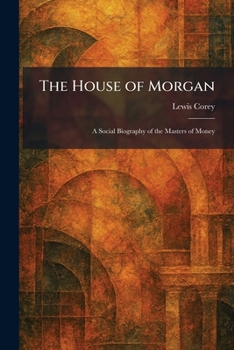
The House of Morgan: A Social Biography of the Masters of Money

Select Format
Select Condition 
Book Overview
"The House of Morgan: A Social Biography of the Masters of Money" is a definitive exploration of one of the most powerful financial dynasties in American history. Written by Lewis Corey, this work provides a comprehensive analysis of the rise of the Morgan banking empire and its profound influence on the economic landscape of the United States. The book traces the trajectory of J.P. Morgan and his associates, illustrating how their control over capital shaped the development of modern industry and the transition toward finance capitalism.
Corey examines the social and economic implications of the Morgan family's dominance, moving beyond simple biography to provide a critical view of the concentration of wealth and power during the late nineteenth and early twentieth centuries. By detailing the formation of trusts, the stabilization of the banking system, and the intersection of private interest with public policy, the work offers essential insights into the mechanisms of the Gilded Age. This study remains a significant historical document for readers interested in the roots of American corporate power and the evolution of global finance.
This work has been selected by scholars as being culturally important, and is part of the knowledge base of civilization as we know it. This work was reproduced from the original artifact, and remains as true to the original work as possible. Therefore, you may see the original copyright references, library stamps (as most of these works have been housed in our most important libraries around the world), and other notations in the work.
This work is in the public domain in the United States of America, and possibly other nations. Within the United States, you may freely copy and distribute this work, as no entity (individual or corporate) has a copyright on the body of the work.
As a reproduction of a historical artifact, this work may contain missing or blurred pages, poor pictures, errant marks, etc. Scholars believe, and we concur, that this work is important enough to be preserved, reproduced, and made generally available to the public. We appreciate your support of the preservation process, and thank you for being an important part of keeping this knowledge alive and relevant.
Customer Reviews
ThriftBooks ® and the ThriftBooks ® logo are registered trademarks of Thrift Books Global, LLC
