


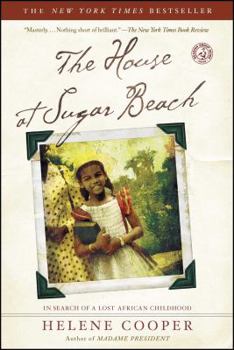
The House at Sugar Beach: In Search of a Lost African Childhood


Select Format
Select Condition 
Book Overview
In this memoir that is "nothing short of brilliant" (The New York Times Book Review), journalist Helene Cooper examines the violent past of her home country Liberia and the effects of its 1980 military coup. Helene Cooper is "Congo," a descendant of two Liberian dynasties--traced back to the first ship of freemen that set sail from New York in 1820 to found Monrovia. Helene grew up at Sugar Beach, a twenty-two-room mansion by the sea. Her childhood was filled with servants, flashy cars, a villa in Spain, and a farmhouse up-country. It was also an African childhood, filled with knock foot games and hot pepper soup, heartmen and neegee. When Helene was eight, the Coopers took in a foster child--a common custom among the Liberian elite. Eunice, a Bassa girl, suddenly became known as "Mrs. Cooper's daughter." For years the Cooper daughters--Helene, her sister Marlene, and Eunice--blissfully enjoyed the trappings of wealth and advantage. But Liberia was like an unwatched pot of water left boiling on the stove. And on April 12, 1980, a group of soldiers staged a coup d' tat, assassinating President William Tolbert and executing his cabinet. The Coopers and the entire Congo class were now the hunted, being imprisoned, shot, tortured, and raped. After a brutal daylight attack by a ragtag crew of soldiers, Helene, Marlene, and their mother fled Sugar Beach, and then Liberia, for America. They left Eunice behind. A world away, Helene tried to assimilate as an American teenager. At the University of North Carolina at Chapel Hill, she found her passion in journalism, eventually becoming a reporter for The Wall Street Journal and The New York Times. She reported from every part of the globe--except Africa--as Liberia descended into war-torn, third-world hell. In 2003, a near-death experience in Iraq convinced Helene that Liberia--and Eunice--could wait no longer. At once a deeply personal memoir and an examination of a violent and stratified country, The House at Sugar Beach tells of tragedy, forgiveness, and transcendence with unflinching honesty and a survivor's gentle humor. And at its heart, it is a story of Helene Cooper's long voyage home.
Format:Paperback
Language:English
ISBN:0743266250
ISBN13:9780743266253
Release Date:July 2009
Publisher:Scribner Book Company
Length:384 Pages
Weight:0.78 lbs.
Dimensions:0.9" x 5.5" x 8.2"
Customer Reviews
5 ratings
The House at Sugar Beach
Published by Thriftbooks.com User , 17 years ago
Having read a number of novels about Africa I was eager to read a memoir by a reporter whose work I admire in the NYT. The book reveals a very different Helene Cooper and, in fact, a very different Liberia from the one I expected. She doesn't put a gloss on the facts, but terrible and painful as some of them are, a reader can feel the pain in the loss of a loved country, friends, family, and childhood.
An amazing story
Published by Thriftbooks.com User , 17 years ago
I am amazed at Ms. Cooper's ability to remember and relate the story of her childhood in Liberia with such clarity and matter of fact openness. In so many ways she had an idyllic childhood, innocent of the strife and upheaval going on around her. That ended abruptly and horrifically, and she was uprooted and taken to America, where she made a life for herself and found her passion in journalism. It makes me happy to see Ms. Cooper at white House press conferences, I feel as if I know her, and I am grateful to her for sharing her story.
The Love of Liberty brought us here...
Published by Thriftbooks.com User , 18 years ago
I walked into Starbucks on Saturday and the title of the book caught my eye...why? because I was born in Liberia and grew up in a house on Sugar Beach. I read the book in 7hrs, emailed all my friends and told them they had to read it. Ms. Cooper took me home after 18yrs away. I was taken back to my life as an 11yr old growing up with my cousin on Sugar Beach. I felt every emotion Ms. Cooper felt when she first moved to Sugar Beach. I laughed and cried all at the same time. It was worth every dollar spent. I do hope to go back to Sugar Beach in the future and see what has become of it.
Going Home Through the Pages of a Book.
Published by Thriftbooks.com User , 18 years ago
Ms. Cooper's story is, in so very many ways, my story, too. I grew up in Liberia, a "second-class" American because we were missionaries and not American Embassy personnel. My years at the American Cooperative School overlapped hers; I had the same first grade teacher as her little sister. I bought ice cream at Sophie's (mind the flies!) and ate hamburgers at Diana's. How many times I drove past that same three-headed palm tree! Like her, I left in my early teens, without properly saying goodbye. Samuel K. Doe's coup d'etat stole Ms. Cooper's childhood; Charles Taylor's invasion in late 1989 stole mine. Much has been said about Liberia's descent into chaos. But what is never spoken of, in all the reports and documentaries, is the old Liberia - the Liberia that I love, the Liberia of my heart, the Liberia of people who have never given up hope, even in the darkest hour, that they can rebuild out the ashes of evil. It will be several years yet before I can make the trip that Ms. Cooper has, and return home. I'd like to stand in our old house on Old Road, if only just to prove that the first 15 years of my life weren't a dream. Maybe the mango tree is still there. In the meantime, I have her book, to help me remember that I have come from somewhere. Home is still there, in the coalpots and red dirt roads, in the potato greens and the palm butter, in the sound of the ocean at night. For all the horrors that war has visited upon my hometown, Liberia stands. The rice bird still sings.
Descent Into Madness For Liberia
Published by Thriftbooks.com User , 18 years ago
Helene Cooper has written a memoir of her privilege African childhood in Liberia before the slaughters of the civil war destroyed the country and her lifestyle. Descended from a family of strong women, she comically describes their mansion at Sugar Beach before the horrors of the soldiers. Written in a you are there style, she conveys all changes of coming to America as a nobody and remaking herself as a journalist. The last part of the book concerns her journey homeward to search for a lost foster sister and to come full circle again.
Copyright © 2026 Thriftbooks.com
Terms of Use | Privacy Policy | Do Not Sell/Share My Personal Information | Cookie Policy | Cookie Preferences | Accessibility Statement
ThriftBooks ® and the ThriftBooks ® logo are registered trademarks of Thrift Books Global, LLC
ThriftBooks ® and the ThriftBooks ® logo are registered trademarks of Thrift Books Global, LLC
