


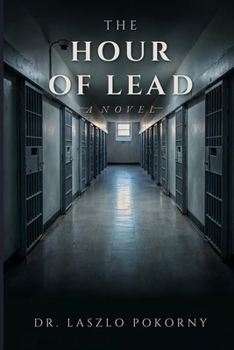
The Hour of Lead
No Customer Reviews

The Hour of Lead is a work of literary fiction that reconstructs one of the defining scandals of the early twenty-first century through the tools of the novel rather than the methods of reportage. Spanning six decades - from a fenced enclave at the edge of Coney Island to the trading floors of Bear Stearns, from the terraced mansions of Palm Beach and the U.S. Virgin Islands to the marble corridors of federal power, and finally to a cell in the Metropolitan Correctional Center on the night of August 9, 2019 - the narrative is organized into four parts and thirty-six chapters, framed by a prologue and epilogue that form a closed temporal ring: both inhabit the final hours before dawn in the jail cell, so that the reader encounters the same objects, the same silence, and the same institutional neglect twice, separated by the entire weight of the story. Drawing on the literary traditions of Hilary Mantel's immersive historical consciousness, Robert Graves's unreliable first-person authority, and the polyphonic moral architecture of Sharon Kay Penman and Ariel Lawhon, the novel transmutes documented history into a sustained act of literary imagination whose truth, as the Author's Note states, is "emotional and structural, not evidentiary." The novel's central formal achievement is its use of composite characters - the survivor Renata Vos, the compliance officer Daniel Ferro, the correctional officer Marcus Okonkwo, among others - to carry the moral weight of many real individuals while defaming no single living person. Each composite serves as a lens onto a distinct register of institutional failure: the unanswered call, the unfiled report, the victim-notification letter drafted and never sent, the non-prosecution agreement that immunized the unnamed, the unwalked round, the dead surveillance camera. Through recurring motifs - the dial tone, the folded orange jumpsuit, the empty second bunk, the incomplete sentence "There is always an arrangement" - the prose builds a symphonic pattern in which every averted eye across twenty-three years rhymes with every other, until the systemic negligence that enabled exploitation and the systemic negligence that produced the death in the cell are revealed as the same mechanism operating at different scales. The title, drawn from Emily Dickinson's poem on the aftermath of great pain, names the novel's governing metaphor: the hour of lead is not one hour but all of them, borne by every person the institutions chose not to hear. At approximately 64,000 words, The Hour of Lead is a mid-length literary novel that combines the intimacy of character-driven fiction with the scope of a historical epic. Its prose style - long, periodic sentences that withhold their main clauses, deliberate repetitions that accumulate like evidence, and a narrative voice that moves between first person, close third, and direct address to the reader - is calibrated to reproduce in the reader the experience of complicity: to make the act of reading feel, by the final page, like the act of watching. It is a book written in the conviction that fiction can honor facts the record alone cannot make felt, and that the story of systemic silence is, finally, a story only a novel - with its power to place a reader inside a locked room at dawn and refuse to look away - is equipped to tell.
Format:Paperback
Language:English
ISBN:B0H9D4LD1P
ISBN13:9798187816293
Release Date:July 2026
Publisher:Independently Published
Length:226 Pages
Weight:0.68 lbs.
Dimensions:0.5" x 6.0" x 9.0"
Customer Reviews
0 rating
Copyright © 2026 Thriftbooks.com
Terms of Use | Privacy Policy | Do Not Sell/Share My Personal Information | Cookie Notice | Cookie Preferences | Accessibility Statement
ThriftBooks ® and the ThriftBooks ® logo are registered trademarks of Thrift Books Global, LLC
ThriftBooks ® and the ThriftBooks ® logo are registered trademarks of Thrift Books Global, LLC
