


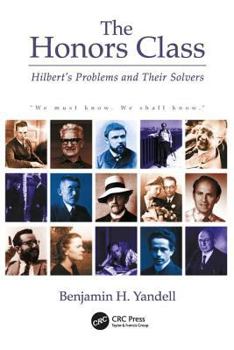
The Honors Class: Hilbert's Problems and Their Solvers

Select Format
Select Condition 
Book Overview
This eminently readable book focuses on the people of mathematics and draws the reader into their fascinating world. In a monumental address, given to the International Congress of Mathematicians in... This description may be from another edition of this product.
Format:Paperback
Language:English
ISBN:1568812167
ISBN13:9781568812168
Release Date:November 2003
Publisher:A K PETERS
Length:498 Pages
Weight:1.48 lbs.
Dimensions:1.1" x 6.0" x 8.9"
Customer Reviews
4 ratings
great mathematicians who contributed to solutions of Hibert's 23 unsolved problems
Published by Thriftbooks.com User , 18 years ago
The Honors Class is the collection of mathematicians that individually or in collaboration solved or partially solved at least one of Hilbert's 23 problems. Yandell does a great of gathering up the historical information so that we have an up-to-date account of the progress on each problem and even how some problems evolved because of their vague or incorrect original proposal. This is a popular math book and is accessible to the nonmathematician such as the fine books by Casti on mathematicians and mathematical developments. It is also similar to Singh's book on Fermat. I think the historical research and accounting of the mathematics deserves 5 stars. I am a little unsure about how well the technical mathematics is conveyed to the layperson however. Admittedly, this is a very difficult task as much of the mathematics is very abstract, especially the early chapters on the foundational questions. The number theory, geometry and even some of the abstract algebra problems are easier to explain and Yandell does a fine job with them. As a mathematician who studied algebra, analysis and even some symbolic logic as an undergraduate and graduate student, I still had a hard time feeling that I got the essence of the mathematics associated with some of these problems. Yandell's discussion is at times detailed but is necessarily sketchy on some of the mathematics. This works for me sometimes but not so well at other times. I think it would be much harder for a novice, but I guess it depends on the depth of understanding one is looking for. I have always found the work of Cantor mysterious and so the ealry chapters that cover Godel and Cohen's amazing results are not the most enlightening for me. I had learned about the axiom of choice in my real analysis classes and was told something about the undecidability of it and its equivalence to the continuum hypothesis but have never really seen the connection or gotten much insight. The material on Paul Cohen is interesting to me because I attended Stanford in the 1970s when he was the buzz of the campus. A younger and less accomplished mathematician compared to many of his famous colleagues in Stanford's prestigious mathematics department, he still was revered because he solved one of Hilbert's problems. Still I am no closer to understanding symbolic logic and the method of deciding whether or not a proposition can be deduced from a set of axioms or can exist independently of the axiom system. I got hooked on the book with the chapter on the tenth problem. This problem seemed more easily understandable and it was very interesting to see how the many players work together and separately to attack the problem including the very interesting Julia Robinson who was a key player in the middle of alll this. The lives of these mathematicians, in some cases their suffering and insanity (similar to Nash) is very interesting and entertaining. There is too much here to handle in one reading. I think this is a book I
A wonderful book!
Published by Thriftbooks.com User , 20 years ago
As a career scientist for over 50 years, I am versed in mathematics but not exactly a mathematician. I bought it to become familiar with Hilbert's problems. I quickly realized that Yandell's book was more about the attempters and solvers than about the problems. Yet the problems are described too, in considerable and certainly sufficient detail. What was ultimately fascinating was the web Yandell weaves throughout the book. Those famous mathematicians and their colleagues, their personal lives, those famous problems, and all integrated so cohesively. When I started reading I knew I was in for a long adventure. In fact, it took me over a year to read - of course, only an hour or so every few days. What extended it was the temptation to go back and reread, again and again. Finally, a week ago, I turned the last page. With great reluctance I put it on my bookshelf. I had a strong urge to start all over again from the very beginning, and I knew if I succumbed I was in for another year with it. As I reflect, partly it was the subject - those difficult problems in such vastly different fields. Partly it was those mathematicians - many of them already heroes of mine. But mostly it was Yandell's skill in putting together this riveting accounting. His love of and fascination with mathematics, and his desire to share his romanticism with others, comes through so clearly. It is sad that he died, at the young age of 53, a scant two years after writing this book. Of a heart attack and multiple sclerosis. What a tragic loss. He was a gem. Even if you are only mildly interested in mathematics, its history and personalities, you will absolutely love this accounting of it.
A page turner
Published by Thriftbooks.com User , 23 years ago
Fascinating historical comments, lively portraits of mathematicians, and their times. While the narrative is about the lives of some great mathematicians, it sucessfully outlines main ideas in the subject,--the personal and scientific context. The author does a great job in sharing his fascination with the rest of us. The book covers roughly the past hundred years. It is a great service to the mathematics community,-- and especially, it is an enjoyment for everyone.It reads like a novel, fast paced, and it is hard to put down. I meant to look at it before going to sleep, but instead read it to the end, finishing in the morning. As a professional mathematician, I am often saddened by how little our work is perhaps understood and appreciated. Books like this can do a lot of good. I can now tell my children that dad does stuff like that.The author brings the events and the mathematical people to life, and he has a story to tell. This book is and will be a success for a long time to come.
Hilbert's Tour of Twentieth Century Mathematics
Published by Thriftbooks.com User , 24 years ago
At the dawn of the twentieth century Hilbert proposed of list of problems that he hoped would be solved in the coming hundred years. The list, later expanded, proved more successful than David Hilbert could have imagined: the problems became canonical, and those who solved them became members of the "Honors Class". Yandell has written a charming biography of the problems and the Honors Class. Hilbert had aimed to make his selection comprehensive, and Yandell's book, organized by branch of mathematics rather than by the number of the problem, turns into something like a description of mathematics itself. The writing is lovely, blending personal information with pithy descriptions of the problems. I thought the mathematics was handled at least as well as in Casti's books, and the balance between the technical and anecdotal was well done. I thought it much more engaging than most of the popular books I have read in the last few years. Yandell can fascinate the neophyte without boring or offending those with a math background. I don't understand why this book is not as well marketed as those of Casti or Singh (or Sobel, come to that), and I hope that potential readers will find The Honors Class. It deserves your attention.
Copyright © 2026 Thriftbooks.com Terms of Use
| Privacy Policy | Do Not
Sell/Share My Personal Information | Cookie Policy | Cookie Preferences | Accessibility Statement
ThriftBooks® and the ThriftBooks® logo are registered trademarks of Thrift Books Global, LLC
ThriftBooks® and the ThriftBooks® logo are registered trademarks of Thrift Books Global, LLC
