


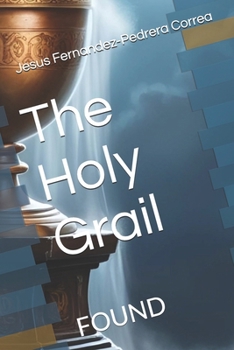
The Holy Grail
No Customer Reviews

The Enigma of the Holy Grail
The Holy Chalice of Valencia: An Academic Analysis of its History, Legends, and Authenticity
The Holy Grail, the legendary cup used by Jesus Christ during the Last Supper, has long captivated humanity's imagination. Numerous accounts, literary works, and theories have sought to uncover its whereabouts and authenticity. Among the various locations claiming possession of this sacred relic, Valencia Cathedral in Spain holds a chalice identified by long-standing tradition and recent academic studies as potentially the authentic Holy Grail.
Legend and Origin
The legend of the Holy Grail gained prominence in medieval Europe through Arthurian literature, particularly "Perceval, the Story of the Grail" by Chr tien de Troyes and "Parzival" by Wolfram von Eschenbach. These works attributed miraculous powers to the chalice, transforming it into a symbol of spiritual quest and purity. According to Christian tradition, this chalice was not only used at the Last Supper but also to collect Christ's blood during the crucifixion, a belief that catalyzed numerous legendary custodial narratives across Europe, often linked to the Knights Templar.
Historical Journey to Valencia
Valencia Cathedral houses a relic identified as the Holy Chalice, with a documented historical trajectory spanning centuries: From Jerusalem to Rome: Tradition claims the upper cup was brought by Saint Peter from Jerusalem to Rome and used by early Popes during Eucharistic celebrations.Arrival in Spain: Escaping persecution under Emperor Valerian in the third century, Pope Sixtus II entrusted the chalice to Deacon Saint Lawrence, who sent it to his hometown, Huesca, in Hispania.Aragonese Custody: The chalice remained hidden in Pyrenean monasteries, notably San Juan de la Pe a from 1071 onwards.Transfer to Valencia: In 1399, King Martin I of Aragon moved the chalice to Zaragoza and subsequently to Barcelona. Alfonso V later transferred it permanently to Valencia Cathedral in 1437, settling a royal debt.Archaeological and Scientific Studies
The Holy Chalice of Valencia comprises several components from different periods: Upper Cup: This piece, made from dark cornelian agate, measures about 7 cm high and 9.5 cm in diameter. Archaeologist Antonio Beltr n dated this piece to between the 1st century BCE and the 1st century CE, matching the era of Christ. Its type corresponds to Hellenistic-Roman cups, likely produced in Eastern workshops (Egypt or Syria).Medieval Additions: The ornate gold base with pearls and gemstones and Arabic inscriptions was added later for liturgical adaptation.Arguments Supporting AuthenticityArchaeological Dating: The cup's dating aligns with the period of Christ's Last Supper.Documented Tradition: Unlike other contenders, the Valencia chalice has a plausible historical trail documented from the 14th century onwards.Material and Origin: Agate's Middle Eastern origin supports its plausibility for use in 1st-century Jerusalem.Recent Investigations
Studies by Dr. Ana Maf Garc a and researcher Manuel Zarzo have strengthened the chalice's historical linkage. Dr. Maf 's doctoral thesis (2019) classified the chalice as a "Kos Kidush Esther," a Jewish blessing cup from the Second Temple period. It matches Jewish halakhic standards: pure stone material, non-porous nature, and specific volumetric measurements (approximately 172 ml).
Manuel Zarzo's 2023 study confirmed the agate's Eastern Mediterranean origin through surface microscopy and petrographic analysis, suggesting Syrian or Egyptian manufacturing around the 1st century, consistent with early Christian liturgical use.
The Holy Chalice of Valencia: An Academic Analysis of its History, Legends, and Authenticity
The Holy Grail, the legendary cup used by Jesus Christ during the Last Supper, has long captivated humanity's imagination. Numerous accounts, literary works, and theories have sought to uncover its whereabouts and authenticity. Among the various locations claiming possession of this sacred relic, Valencia Cathedral in Spain holds a chalice identified by long-standing tradition and recent academic studies as potentially the authentic Holy Grail.
Legend and Origin
The legend of the Holy Grail gained prominence in medieval Europe through Arthurian literature, particularly "Perceval, the Story of the Grail" by Chr tien de Troyes and "Parzival" by Wolfram von Eschenbach. These works attributed miraculous powers to the chalice, transforming it into a symbol of spiritual quest and purity. According to Christian tradition, this chalice was not only used at the Last Supper but also to collect Christ's blood during the crucifixion, a belief that catalyzed numerous legendary custodial narratives across Europe, often linked to the Knights Templar.
Historical Journey to Valencia
Valencia Cathedral houses a relic identified as the Holy Chalice, with a documented historical trajectory spanning centuries: From Jerusalem to Rome: Tradition claims the upper cup was brought by Saint Peter from Jerusalem to Rome and used by early Popes during Eucharistic celebrations.Arrival in Spain: Escaping persecution under Emperor Valerian in the third century, Pope Sixtus II entrusted the chalice to Deacon Saint Lawrence, who sent it to his hometown, Huesca, in Hispania.Aragonese Custody: The chalice remained hidden in Pyrenean monasteries, notably San Juan de la Pe a from 1071 onwards.Transfer to Valencia: In 1399, King Martin I of Aragon moved the chalice to Zaragoza and subsequently to Barcelona. Alfonso V later transferred it permanently to Valencia Cathedral in 1437, settling a royal debt.Archaeological and Scientific Studies
The Holy Chalice of Valencia comprises several components from different periods: Upper Cup: This piece, made from dark cornelian agate, measures about 7 cm high and 9.5 cm in diameter. Archaeologist Antonio Beltr n dated this piece to between the 1st century BCE and the 1st century CE, matching the era of Christ. Its type corresponds to Hellenistic-Roman cups, likely produced in Eastern workshops (Egypt or Syria).Medieval Additions: The ornate gold base with pearls and gemstones and Arabic inscriptions was added later for liturgical adaptation.Arguments Supporting AuthenticityArchaeological Dating: The cup's dating aligns with the period of Christ's Last Supper.Documented Tradition: Unlike other contenders, the Valencia chalice has a plausible historical trail documented from the 14th century onwards.Material and Origin: Agate's Middle Eastern origin supports its plausibility for use in 1st-century Jerusalem.Recent Investigations
Studies by Dr. Ana Maf Garc a and researcher Manuel Zarzo have strengthened the chalice's historical linkage. Dr. Maf 's doctoral thesis (2019) classified the chalice as a "Kos Kidush Esther," a Jewish blessing cup from the Second Temple period. It matches Jewish halakhic standards: pure stone material, non-porous nature, and specific volumetric measurements (approximately 172 ml).
Manuel Zarzo's 2023 study confirmed the agate's Eastern Mediterranean origin through surface microscopy and petrographic analysis, suggesting Syrian or Egyptian manufacturing around the 1st century, consistent with early Christian liturgical use.
Format:Paperback
Language:English
ISBN:B0F9FHMD8H
ISBN13:9798284654644
Release Date:May 2025
Publisher:Independently Published
Length:94 Pages
Weight:0.30 lbs.
Dimensions:0.2" x 6.0" x 9.0"
Customer Reviews
0 rating
Copyright © 2026 Thriftbooks.com
Terms of Use | Privacy Policy | Do Not Sell/Share My Personal Information | Cookie Policy | Cookie Preferences | Accessibility Statement
ThriftBooks ® and the ThriftBooks ® logo are registered trademarks of Thrift Books Global, LLC
ThriftBooks ® and the ThriftBooks ® logo are registered trademarks of Thrift Books Global, LLC
