


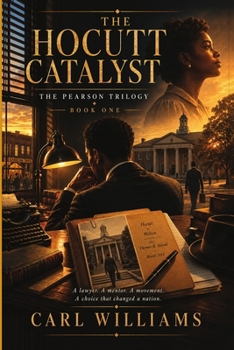
The Hocutt Catalyst: The Pearson Trilogy

They went to open the University of North Carolina. The door was barred from the inside.
Durham, 1933. On Parrish Street, in the few blocks the country lets a Black town call its own, two young lawyers keep an office above the noise of Black Wall Street. Conrad Pearson and Cecil McCoy have more nerve than money and a conviction that the law can be made to do what the country will not. With Louis Austin and his Carolina Times behind them, they look for a client brave enough to be the test, and they find him in Thomas Hocutt, a young man who wants only to study pharmacy at a university that will not admit him.
What follows is the first true assault on the color line in Southern higher education, fought a full generation before anyone had heard of Brown. William Hastie comes down from the North to argue it. A sharp young woman named Pauli Murray watches from the gallery and takes the measure of everything. And the state, for all its power, never has to lift a hand to win. The case dies on a single withheld document, kept back by a Black college president who has decided the price of the fight is too high.
They lose. They lose in an afternoon, in a hall that empties around them, and the loss teaches them the thing no victory could have. Told by the aging lawyer Anthony Brakes to a room of students who believe the hard part is behind them, this is the story of how a defeat became a blueprint, and how a handful of people in one Southern town refused to let the record forget the man they could not save.
They called it a defeat. History would call it the catalyst.
Customer Reviews
ThriftBooks ® and the ThriftBooks ® logo are registered trademarks of Thrift Books Global, LLC
