


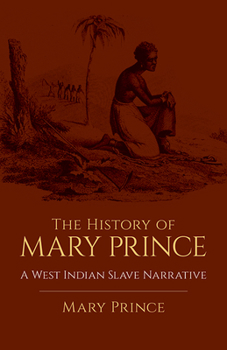
The History of Mary Prince: A West Indian Slave Narrative


Select Format
Select Condition 
Book Overview
Born in Bermuda to a house slave in 1788, Mary Prince suffered the first of many soul-shattering experiences in her life when she was separated from her parents and siblings at the age of twelve. Subjected to bodily and sexual abuse by subsequent masters, she was bought and sold several times before she was ultimately freed. The first black woman to break the bonds of slavery in the British colonies and publish a record of her experiences, Prince vividly recalls her life in the West Indies, her rebellion against physical and psychological degradation, and her eventual escape in 1828 in England. Her straightforward, often poetic account of immense anguish, separation from her husband, and struggle for freedom inflamed public opinion during a period when stormy debates on abolition were common in both the United States and England. This edition also includes a substantial supplement by Thomas Pringle, the original editor, as well as another brief slave account: "The Narrative of Asa-Asa, a Captured African." Essential reading for students of African-American studies, Mary Prince's classic account of determination and endurance aids in filling the many gaps in black women's history.
Format:Paperback
Language:English
ISBN:0486438635
ISBN13:9780486438634
Release Date:October 2004
Publisher:Dover Publications
Length:69 Pages
Weight:0.62 lbs.
Dimensions:0.2" x 5.7" x 8.4"
Related Subjects
African-American Studies Americas Biographical Biographies Biographies & History Biography & History Discrimination & Racism Ethnic & National Ethnic Studies History Literary Literary Criticism & Collections Literature Literature & Fiction Minority Studies Politics & Social Sciences Race Relations Slavery & Emancipation Social Science Social Sciences Specific DemographicsCustomer Reviews
3 ratings
Very informative book
Published by Thriftbooks.com User , 17 years ago
I love this book, I got the book to learn more about slavery in the Caribbean and it gave not only an insider view but also the story about how slaves were captured in Africa was a great added bonus.
An important document of the slave experience
Published by Thriftbooks.com User , 25 years ago
Born in Bermuda in the late 18th century, Mary Prince was a Black woman who survived enslavement in the colonial world of the Caribbean. She orally told her story to a third party, who transcribed it. First published in England in 1831, "The History of Mary Prince, a West Indian Slave" is one of the most important narratives of the slave experience in the Americas.This book describes in detail the reality of the slave experience: the dehumanization of Black people, the moral degradation of their masters, and the ever-present violence. Prince's story is also an important early defense of the humanity of people of African descent. She notes that slave masters "think that black people are like cattle, without natural affection. But my heart tells me it is far otherwise."Prince tells of her labor in the salt ponds of Turk's Island, her conflict with a hired mulatto woman, her spiritual life in the Moravian Church, and many other topics. Ultimately, she celebrates the desire and hope for freedom: "All slaves want to be free.""The History of Mary Prince" does not quite attain the level of literary craftsmanship and psychological complexity as do some other classic slave narratives (I am thinking in particular of those of Frederick Douglass and Harriet Jacobs). But it is still a powerful, authoritative, and important human testament. Mary Prince declares, "I have been a slave--I have felt what a slave feels, and I know what a slave knows." We of later centuries need to hear her words.
A Woman's Voice and the Experience of Slavery
Published by Thriftbooks.com User , 25 years ago
First published in 1831, "The History of Mary Prince" is an extraordinary cultural document. It is the first published account of a female British ex-slave. Mary Prince, a slave in the West Indies in the late 18th and early 19th centuries, tells the story of her life in an effort to awaken sympathy for the abolitionist movement in England.Mary particularly emphasizes instances of the arbitrary punishments meted out by her various masters. She repeatedly questions how the British, a civilized nation, could permit its colonists to treat its colonial work force like brute beasts. Mary elicits our attention and respect in the ways she manages to resist the brutality of her masters, both physically and vocally. She often shows herself speaking out against cruelty regardless of social taboos, accepted colonial norms of unquestioning obedience, and the image of the "benevolent" slave owner.Mary's narrative is also remarkable for her characterization as the "self-made heroine." Mary tells us extensively about her attempts to save enough money to purchase her freedom, and to engage, convert, and marry the man of her choice. As the editor of this edition points out, as Mary begins to learn the value of her labor, she more easily manipulates her owners into realizing their own powerlessness over her. A sort of Wollstonecraftian feminist hero, Mary Prince bases her self-definition on her ability to be financially, as well as physically independent, and to improve herself through education and religion. One limitation of "The History of Mary Prince" is the fact that it was only dictated by Prince. It was transcribed and published by British abolitionists, who may have suggested the emphasis on brutality and deemphasis on specifically sexual violence. It is impossible to know the extent of the editing process, which was out of Prince's hands. Nonetheless, this edition, edited by Moira Ferguson, contains many relevant historical documents which provide a rich context for Prince's narrative.
Copyright © 2026 Thriftbooks.com Terms of Use
| Privacy Policy | Do Not
Sell/Share My Personal Information | Cookie Policy | Cookie Preferences | Accessibility Statement
ThriftBooks® and the ThriftBooks® logo are registered trademarks of Thrift Books Global, LLC
ThriftBooks® and the ThriftBooks® logo are registered trademarks of Thrift Books Global, LLC
