


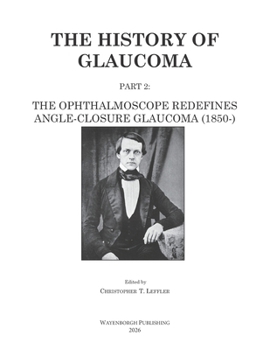
The History of Glaucoma: The Ophthalmoscope Redefines Angle-Closure Glaucoma (1850-)
No Customer Reviews

The History of Glaucoma: Part II - The Ophthalmoscope Redefines Angle-Closure Glaucoma (1850- )
The invention of the ophthalmoscope in 1850 transformed our conception of glaucoma forever. For the first time, physicians could directly observe the living optic nerve, leading to a revolution in the understanding, diagnosis, and treatment of one of the world's leading causes of blindness.
This volume chronicles the remarkable advances that followed Hermann Helmholtz's invention of the ophthalmoscope, including the recognition of glaucoma as a pressure-induced optic neuropathy, the discovery of aqueous humor dynamics, the emergence of angle-closure glaucoma as a distinct disease, the history of malignant glaucoma, and the rise and eventual abandonment of sympathectomy for glaucoma.
Drawing upon original publications, rare historical illustrations, and modern historical scholarship, this richly illustrated volume follows the scientific discoveries, technological innovations, and clinical insights that reshaped glaucoma during the second half of the nineteenth century and beyond.
Written for ophthalmologists, historians of medicine, and anyone interested in the history of science, this volume reveals how one instrument changed not only ophthalmology, but our understanding of glaucoma itself. Table of contents
1. Helmholtz and the Development of the Ophthalmoscope
2. Glaucoma: A Pressure-Induced Optic Neuropathy (1850-1870)
3. Aqueous humor dynamics
4. Angle Closure Glaucoma Since 187
5. The History of Malignant Glaucoma
6 Sympathectomy for glaucoma: its rise and fall (1898-1910)
Format:Paperback
Language:English
ISBN:9062993419
ISBN13:9789062993413
Release Date:July 2026
Publisher:Wayenborgh Publishing
Length:164 Pages
Weight:0.87 lbs.
Dimensions:0.3" x 8.5" x 11.0"
Related Subjects
Medical Medical Books Science Science & Math Science & Scientists Science & TechnologyCustomer Reviews
0 rating
Copyright © 2026 Thriftbooks.com
Terms of Use | Privacy Policy | Do Not Sell/Share My Personal Information | Cookie Notice | Cookie Preferences | Accessibility Statement
ThriftBooks ® and the ThriftBooks ® logo are registered trademarks of Thrift Books Global, LLC
ThriftBooks ® and the ThriftBooks ® logo are registered trademarks of Thrift Books Global, LLC
