


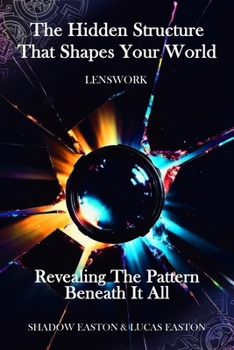
The Hidden Structure That Shapes Your World: Revealing The Pattern Beneath It All

You don't see the world as it is.
You see it through a structure you didn't build, don't control, and almost never question.
It decides what feels obvious.
It decides what feels true.
It decides what you defend... and what you reject.
And the most dangerous part?
You don't see it while it's happening.
Have you ever walked away from an argument completely certain you were right, convinced the other person simply couldn't see what was obvious?
Have you noticed how the same debates repeat endlessly, politics, religion, identity, culture, with almost no one changing their mind?
It doesn't matter how much information is presented.
It doesn't matter how strong the evidence is.
Something else is at work.
This book reveals what that "something" is.
In The Hidden Structure That Shapes Your World, Lucas Easton and Shadow Easton expose the underlying pattern that turns:
experience → into interpretation
interpretation → into belief
belief → into something that feels like truth
And once that process begins, it quietly protects itself.
What You Will Start to See
Once you recognize this structure, the shift is immediate.
Arguments stop being about truth.
Beliefs stop feeling personal.
Certainty starts to look constructed.
You begin to notice:
- why people defend ideas so intensely
- why debates go in circles
- why facts rarely change minds
- how identity forms around belief
- how even your own thinking stabilizes itself
The world doesn't change. But how it appears to you does.
What This Book Is (And What It Isn't)
This is not a book about what to believe.
It will not give you answers.
It will not offer a new ideology.
It will not replace one system with another.
Instead, it shows you the mechanism behind all of them.
At the center of the book is Lenswork - a way of seeing the exact moment where:
experience becomes interpretation
interpretation becomes belief
belief becomes identity
And identity begins to defend itself.
Why This Matters
Most conflict is not caused by events.
It is caused by the structure forming around those events.
That structure determines:
- what you notice
- what you ignore
- what feels right
- what feels wrong
And because it operates automatically, it rarely gets questioned.
Once You See It...
This is where the book becomes different.
Because this is not an idea you "agree" or "disagree" with.
It's something you start noticing.
In conversations.
In media.
In institutions.
In yourself.
And once that happens, something shifts.
Not what you think.
But how thinking itself operates.
A Different Kind of Clarity
In a world driven by certainty, polarization, and endless debate, this book offers something rare.
Not answers.
Clarity.
The ability to see the structure beneath it all.
And once you see it... you won't be able to unsee it.
Customer Reviews
ThriftBooks ® and the ThriftBooks ® logo are registered trademarks of Thrift Books Global, LLC
