


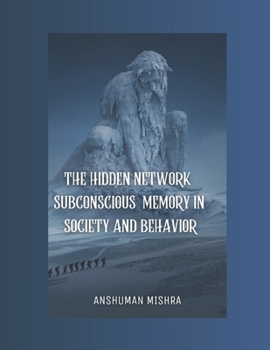
The Hidden Network Subconscious Memory in Society and Behavior
No Customer Reviews

Every society thinks - not in the way an individual does, through sentences or deliberate reasoning, but through the invisible currents of emotion, imitation, and memory that pass between people. Long before we invented written language or digital code, humanity was already forming networks of shared feeling and collective intelligence.
When we gather in crowds, follow trends, believe in ideologies, or mourn a loss as a nation, something larger than any single individual is thinking through us. It is this hidden layer of social cognition - the subconscious mind of society - that The Hidden Network: Subconscious Memory in Society and Behavior seeks to explore.
This book is a journey into that invisible field of connection - the shared memory and emotion that shapes how groups behave, how cultures evolve, and how ideas spread. It connects psychology, sociology, cognitive science, anthropology, and artificial intelligence to explain how society itself learns and remembers, just like a vast neural network.
In an age where human life has become inseparable from digital systems, understanding the subconscious behavior of societies is not only fascinating - it is necessary. Our social networks are no longer metaphorical; they are literal architectures of data and emotion, influencing billions every day.
The book argues that the same principles governing AI learning - pattern recognition, feedback loops, and memory storage - also exist in human culture, albeit subconsciously. Every tradition, meme, and ideology is a data trace of social learning. Every revolution, trend, or moral movement is the result of feedback loops within this hidden network of collective behavior.
Part I - The Roots of Collective Intelligence
Human beings are wired for connection. The first part of the book traces the evolutionary and psychological roots of our social mind. Long before cities or civilizations, prehistoric humans survived through shared attention, imitation, and cooperative emotion. These capacities - empathy, communication, and the need for belonging - are the building blocks of collective cognition.The Biological OriginsEvolution did not simply design us to think individually but to think together. Mirror neurons, the biological foundation of empathy, allow humans to feel what others feel. Through this neural mirroring, individuals become part of a shared field of emotion - the first version of what we now call "collective consciousness."
In early tribes, this shared emotional field enabled coordination and cooperation. It was the beginning of what would become religion, culture, and morality - all systems that encode shared behavior through emotional resonance rather than rational instruction.The First Social NetworksBefore the internet, there were oral traditions - stories, songs, and rituals that carried information through memory rather than media. Each story, each symbol, became a mnemonic unit - a kind of social neuron connecting individuals to the tribe's collective past. The structure of these traditions mirrors modern data networks: distributed, redundant, and adaptive.
By the time humanity entered the agricultural and urban ages, these networks of meaning had expanded into civilizations. Society itself became a cognitive organism, with religion as its emotional cortex, mythology as its memory system, and ritual as its mechanism of continuity. Part II - The Subconscious Memory of Society
Collective memory is not stored in brains alone but in symbols, architecture, languages, and institutions. Just as neurons encode experiences in synaptic pathways, societies encode experiences in rituals, laws, and cultural narratives.
The second part of the book delves into how societies remember - and forget.
When we gather in crowds, follow trends, believe in ideologies, or mourn a loss as a nation, something larger than any single individual is thinking through us. It is this hidden layer of social cognition - the subconscious mind of society - that The Hidden Network: Subconscious Memory in Society and Behavior seeks to explore.
This book is a journey into that invisible field of connection - the shared memory and emotion that shapes how groups behave, how cultures evolve, and how ideas spread. It connects psychology, sociology, cognitive science, anthropology, and artificial intelligence to explain how society itself learns and remembers, just like a vast neural network.
In an age where human life has become inseparable from digital systems, understanding the subconscious behavior of societies is not only fascinating - it is necessary. Our social networks are no longer metaphorical; they are literal architectures of data and emotion, influencing billions every day.
The book argues that the same principles governing AI learning - pattern recognition, feedback loops, and memory storage - also exist in human culture, albeit subconsciously. Every tradition, meme, and ideology is a data trace of social learning. Every revolution, trend, or moral movement is the result of feedback loops within this hidden network of collective behavior.
Part I - The Roots of Collective Intelligence
Human beings are wired for connection. The first part of the book traces the evolutionary and psychological roots of our social mind. Long before cities or civilizations, prehistoric humans survived through shared attention, imitation, and cooperative emotion. These capacities - empathy, communication, and the need for belonging - are the building blocks of collective cognition.The Biological OriginsEvolution did not simply design us to think individually but to think together. Mirror neurons, the biological foundation of empathy, allow humans to feel what others feel. Through this neural mirroring, individuals become part of a shared field of emotion - the first version of what we now call "collective consciousness."
In early tribes, this shared emotional field enabled coordination and cooperation. It was the beginning of what would become religion, culture, and morality - all systems that encode shared behavior through emotional resonance rather than rational instruction.The First Social NetworksBefore the internet, there were oral traditions - stories, songs, and rituals that carried information through memory rather than media. Each story, each symbol, became a mnemonic unit - a kind of social neuron connecting individuals to the tribe's collective past. The structure of these traditions mirrors modern data networks: distributed, redundant, and adaptive.
By the time humanity entered the agricultural and urban ages, these networks of meaning had expanded into civilizations. Society itself became a cognitive organism, with religion as its emotional cortex, mythology as its memory system, and ritual as its mechanism of continuity. Part II - The Subconscious Memory of Society
Collective memory is not stored in brains alone but in symbols, architecture, languages, and institutions. Just as neurons encode experiences in synaptic pathways, societies encode experiences in rituals, laws, and cultural narratives.
The second part of the book delves into how societies remember - and forget.
Format:Paperback
Language:English
ISBN:B0FXKQ7RNB
ISBN13:9798271267888
Release Date:October 2025
Publisher:Independently Published
Length:170 Pages
Weight:0.90 lbs.
Dimensions:0.4" x 8.5" x 11.0"
Customer Reviews
0 rating
Copyright © 2026 Thriftbooks.com Terms of Use
| Privacy Policy | Do Not
Sell/Share My Personal Information | Cookie Policy | Cookie Preferences | Accessibility Statement
ThriftBooks® and the ThriftBooks® logo are registered trademarks of Thrift Books Global, LLC
ThriftBooks® and the ThriftBooks® logo are registered trademarks of Thrift Books Global, LLC
