


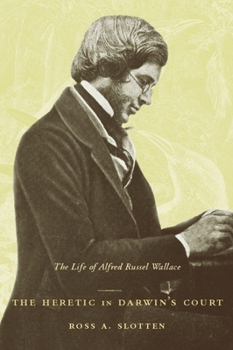
The Heretic in Darwin's Court: The Life of Alfred Russel Wallace

Select Format
Select Condition 
Book Overview
During their lifetimes, Alfred Russel Wallace and Charles Darwin shared credit and fame for the independent and near-simultaneous discovery of natural selection. Together, the two men spearheaded one of the greatest intellectual revolutions in modern history, and their rivalry, usually amicable but occasionally acrimonious, forged modern evolutionary theory. Yet today, few people today know much about Wallace. The Heretic in Darwin's Court explores the controversial life and scientific contributions of Alfred Russel Wallace--Victorian traveler, scientist, spiritualist, and co-discoverer with Charles Darwin of natural selection. After examining his early years, the biography turns to Wallace's twelve years of often harrowing travels in the western and eastern tropics, which place him in the pantheon of the greatest explorer-naturalists of the nineteenth century. Tracing step-by-step his discovery of natural selection--a piece of scientific detective work as revolutionary in its implications as the discovery of the structure of DNA--the book then follows the remaining fifty years of Wallace's eccentric and entertaining life. In addition to his divergence from Darwin on two fundamental issues--sexual selection and the origin of the human mind--he pursued topics that most scientific figures of his day conspicuously avoided, including spiritualism, phrenology, mesmerism, environmentalism, and life on Mars. Although there may be disagreement about his conclusions, Wallace's intellectual investigations into the origins of life, consciousness, and the universe itself remain some of the most inspired scientific accomplishments in history. This authoritative biography casts new light on the life and work of Alfred Russel Wallace and the importance of his twenty-five-year relationship with Charles Darwin.
Format:Hardcover
Language:English
ISBN:0231130104
ISBN13:9780231130103
Release Date:January 2004
Publisher:Columbia University Press
Length:602 Pages
Weight:2.21 lbs.
Dimensions:1.6" x 6.4" x 9.3"
Grade Range:Postsecondary and higher
Customer Reviews
4 ratings
A. R. Wallace as he really was.
Published by Thriftbooks.com User , 19 years ago
This is by far the best of several recent biographies of Wallace. As a biographer myself, it is hard for me to grasp how Dr. Totten, as a physician, ever found the time to do the meticulous research for this book. While it contains a wealth of end notes, the narrative does not make difficult reading. The author does not insert his own biases in his treatment of the portion of the book that deals in Wallace's spiritualiam.
Should it be called the Darwin-Wallace Theory?
Published by Thriftbooks.com User , 19 years ago
The story of Darwin's voyage around the world in the Beagle is well known. He used his observations and the time (you have a lot of time on a sailing ship) to develop the basics of the theory of evolution. After his return to England, he wrote up his findings but did not publish them. Wallace spent a long time making similar observations, but was haunted by ill fortune. For instance his collection of specimens laboriously collected was being shipped to England when the ship they were on caught fire, and the specimens were lost. Wallace's thoughts though were running along similar lines with that of Darwin. When he was getting ready to publish people told Darwin that his theories were about to be published by Wallace. Darwin then rushed his theory into print and now the theory is Darwin's theory rather than Wallace's theory. What isn't very well known is that Darwin and Wallace were able to then work together for many years to further develop the theory. Perhaps a better name would be the Darwin-Wallace theory. This is a very well written addition to the literature and Dr. Slotten's obvious dedication comes through.
More Wallace
Published by Thriftbooks.com User , 21 years ago
Ross Slotten's new biography of Alfred Russel Wallace (1823-1913) continues where others have left off. There has now been at least one full-length biographical study of Wallace published each year since 2000, plus several anthologies and other works. Clearly, Wallace is starting to "get his due." But there is yet much to do, and this latest biography demonstrates this point well. Slotten is an amateur investigator, and this work was obviously a labor of love. But he's put a good deal of effort into his study, along the way uncovering new archival sources that shed further light on Wallace's many contacts over his long life. So, the reader will find further new things here, even if he or she has already digested the recent excellent studies by Peter Raby, Michael Shermer, and Martin Fichman. Slotten writes well, provides enough historical context to keep things interesting, and only occasionally is factually inaccurate (for example, in some of the chronology he offers for the period of Wallace's adoption of spiritualism, circa 1865-1866). On the other hand, his efforts sometimes cross over into ill-advised opinion and elaboration. One thing he plays a bit too much on is Wallace's status as an outsider to the intellectual community of his time: the "poor Wallace" line (in relation to his dealings with Darwin, and everyone else). Actually, though Wallace was in fact an outsider, the real story of his life is how little such matters seemed to affect his thought process: when it came to the world of ideas, he was just about as fearless a thinker as we have had. Slotten does a rather poor job of exposing this side--the really important one--of Wallace, and to this extent does just about nothing to expand our knowledge of his world view past the status quo. But for someone as unusual as Wallace, one cannot ask for everything at once. We should be happy for a well-written, well-researched, and admirably detailed accounting of a very interesting man's life, and continue to hope that future treatments will reach more and more into just what made Wallace tic, and how we in our time can make use of that information.
The "Indiana Jones" of Evolution
Published by Thriftbooks.com User , 21 years ago
This book was recommended by a friend. It's a great read, and would make a great action movie. I dimly remembered someone simultaneously developing a theory of evolution with Darwin. After reading this book, I don't know why Wallace isn't more famous than Darwin. He was certainly more interesting. He was self-made, from London's lower classes; trecked around the jungles of South America and the Pacific islands; was involved in a shipwreck; was recognized by England's most prestigious scientific societies; got involved in unpopular social causes and ended up going to seances and visiting mediums. This cost him him his hard-won scientific standing in Victorian London, but that didn't seem to phase him; he had moved on intellectually. He is a fascinating and colorful character. The author doesn't try to explain away the contradictions, but lets Wallace emerge as what he is -- a complexs and enigmatic, and ultimately very sympathetic figure. The book is also a fascinating study of Victorian England. It also contains a very lucid discussion of the thought process that led to the theory of evolution, which becomes almost a sub-plot, with its own heros and villains. This author writes in a clear, lucid prose, and lets his opinion occasionally show through, but generally plays it straight. The scholarship is impressive, but you aren't overwhelmed by it. The author keeps a critical distance from the character, so the portrayal feels ultimately balanced. If you are looking for a good biography, this is a book you should relish.
Copyright © 2025 Thriftbooks.com
Terms of Use | Privacy Policy | Do Not Sell/Share My Personal Information | Cookie Policy | Cookie Preferences | Accessibility Statement
ThriftBooks ® and the ThriftBooks ® logo are registered trademarks of Thrift Books Global, LLC
ThriftBooks ® and the ThriftBooks ® logo are registered trademarks of Thrift Books Global, LLC
