


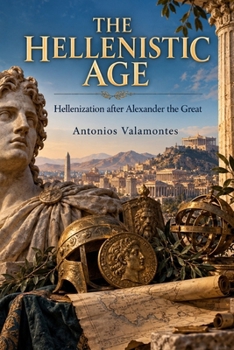
The Hellenistic Age: Hellenization after Alexander The Great

The Hellenistic Age: Hellenization after Alexander the Great examines the political, cultural, linguistic, and institutional transformations that followed Alexander's death in 323 BC and reshaped the Mediterranean, Near East, Central Asia, and parts of South Asia.
Rather than treating the Hellenistic world as a simple extension of Classical Greece or as a prelude to Roman domination, Antonios Valamontes reconstructs it as a complex historical system of successor kingdoms, cities, military settlements, commercial networks, cultural exchange, and competing identities.
The book follows the struggles of the Diadochi and the formation of the Ptolemaic, Seleucid, Antigonid, Greco-Bactrian, and Indo-Greek worlds while examining how Greek language, coinage, education, civic institutions, art, philosophy, science, military organization, and religious vocabulary spread far beyond the Aegean.
Particular attention is given to the regional character of Hellenization. Greek institutions could be adopted without erasing local languages, religions, political traditions, or ethnic identities. Bactria, India, Judaea, Egypt, Asia Minor, the Black Sea, and the wider eastern Mediterranean each demonstrate different patterns of adaptation, resistance, coexistence, and synthesis.
The later chapters explore the rise of Rome, the endurance of Greek cultural institutions after political conquest, Jewish interaction with the Hellenistic world, the development of Greek Jewish literature, afterlife traditions, and the Mediterranean diaspora.
This revised and expanded 2026 edition incorporates a substantially strengthened evidentiary framework, original-language source passages with translations, corrected chronology, expanded regional analysis, updated bibliography, chronology, and analytical index.
A study of conquest, cultural transmission, and the durability of institutions, The Hellenistic Age presents the centuries after Alexander as one of antiquity's most consequential periods of political fragmentation and cultural connection.
Related Subjects
HistoryCustomer Reviews
ThriftBooks ® and the ThriftBooks ® logo are registered trademarks of Thrift Books Global, LLC
