


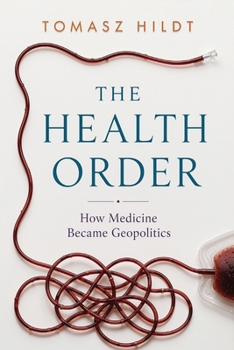
The Health Order: How Medicine Became Geopolitics

A delegation of European scientists had just presented a breakthrough. The official who had listened in silence asked a single question: where will the data live? They thought they were in a sales meeting. They were in a sovereignty negotiation, and they had already lost it.
We are taught that medicine is a matter of science and compassion, occasionally corrupted by money but essentially noble in its architecture. Tomasz Hildt argues the opposite. Health has become one of the primary arenas of hard geopolitics in the twenty-first century, and the West is losing it while applauding itself.
Drawing on years spent judging medical innovation from inside the Prix Galien juries, and on work spanning Central and Eastern Europe and the Gulf, Hildt makes a case that runs against the official story of global medicine. There is no global commons of healing, only several systems of sovereign power that trade molecules while surrendering none of their leverage. Penicillin saved almost no one for a decade after Fleming discovered it, and the West no longer manufactures it. A German patient waits 128 days for a newly approved medicine; a Romanian waits 1,201. Roughly 82 per cent of the active ingredients in American medicines originate in China and India. The Gulf states are sequencing their populations and keeping the results, while Europe generates some of the finest health data in the world and hands it away, dataset by dataset.
THE HEALTH ORDER argues that the molecule is not the innovation - the capacity to deliver it is - and that whoever controls manufacturing, genomic data, and the sovereign ability to turn discovery into delivered care holds a power over other nations more intimate than any weapon and more durable than any tariff.
Written for readers in global health, international relations, health policy and pharmaceutical strategy, the book has been added to the reading list of the University of Copenhagen's Summer Course in Global Health Challenges.
Tomasz Hildt spent two decades at the top of international marketing and communications before crossing into medical innovation. He leads the Galien Foundation's operations across the Middle East and Central and Eastern Europe, and Prix Galien Middle East.
Customer Reviews
ThriftBooks ® and the ThriftBooks ® logo are registered trademarks of Thrift Books Global, LLC
