


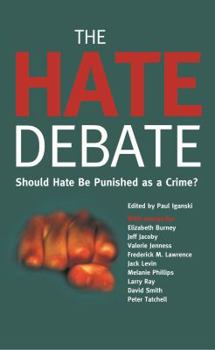
The Hate Debate : Should Hate Be Punished As a Crime?
No Customer Reviews

Is justice served when someone committing an act of violence because of prejudice is punished more severely than someone who perpetrates the same assault for other reasons? That's the question posed by critics of 'hate crime' laws in the United States. It is also the central question addressed in The Hate Debate. Opponents say that hate crime laws infringe one's right to freedom of expression. They maintain that 'extra punishment' is not for the act itself, but for the bad values and thoughts motivating the crime. On the other hand, supporters of hate crime laws argue that greater punishment is warranted because, in effect, hate crimes hurt more. The societal and other harms make hate crimes qualitatively different from crimes motivated on other grounds. What explains the emergence and extension of hate crime laws in the United States and in Britain? Do hate crime laws really create 'thought crimes'? Is extra punishment the best way to deal with hate? This collection of essays by leading commentators on both sides of the Atlantic seeks to clear a path through the current debate.
Format:Paperback
Language:English
ISBN:1861974493
ISBN13:9781861974495
Release Date:January 2002
Publisher:Profile Books
Length:160 Pages
Weight:0.55 lbs.
Dimensions:8.5" x 0.5" x 5.4"
Customer Reviews
0 rating
Copyright © 2026 Thriftbooks.com
Terms of Use | Privacy Policy | Do Not Sell/Share My Personal Information | Cookie Policy | Cookie Preferences | Accessibility Statement
ThriftBooks ® and the ThriftBooks ® logo are registered trademarks of Thrift Books Global, LLC
ThriftBooks ® and the ThriftBooks ® logo are registered trademarks of Thrift Books Global, LLC
