


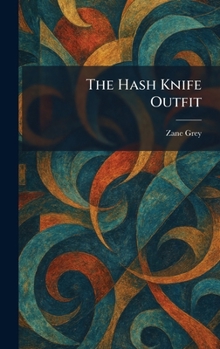
The Hash Knife Outfit

Select Format
Select Condition 
Book Overview
"The Hash Knife Outfit" is a gripping Western novel by the legendary Zane Grey that plunges readers into the lawless heart of the Arizona frontier. The story centers on a notorious band of outlaws known as the Hash Knife Outfit, a ruthless gang of cattle rustlers who terrorize the Tonto Basin. At the center of the conflict is young Glory Traft, who finds herself caught between her uncle's ranching legacy and the dangerous allure of the wild landscape. As tensions escalate between the honest cattlemen and the desperate bandits, Grey weaves a tale of suspense, romance, and rugged justice.
With vivid descriptions of the sweeping canyons and dusty trails of the Old West, "The Hash Knife Outfit" showcases Grey's mastery of the Western genre. The narrative explores themes of loyalty, survival, and the clash between civilization and the untamed wilderness. This classic work captures the spirit of the frontier, offering a pulse-pounding adventure filled with high-stakes gunfights and the enduring struggle to establish order in a land governed by the gun.
This work has been selected by scholars as being culturally important, and is part of the knowledge base of civilization as we know it. This work was reproduced from the original artifact, and remains as true to the original work as possible. Therefore, you may see the original copyright references, library stamps (as most of these works have been housed in our most important libraries around the world), and other notations in the work.
This work is in the public domain in the United States of America, and possibly other nations. Within the United States, you may freely copy and distribute this work, as no entity (individual or corporate) has a copyright on the body of the work.
As a reproduction of a historical artifact, this work may contain missing or blurred pages, poor pictures, errant marks, etc. Scholars believe, and we concur, that this work is important enough to be preserved, reproduced, and made generally available to the public. We appreciate your support of the preservation process, and thank you for being an important part of keeping this knowledge alive and relevant.
Customer Reviews
The Yellow Jacket Feud
ThriftBooks ® and the ThriftBooks ® logo are registered trademarks of Thrift Books Global, LLC
