


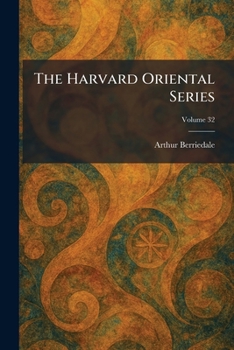
The Harvard Oriental Series

The Religion and Philosophy of the Veda and Upanishads is an authoritative and comprehensive examination of the spiritual and intellectual foundations of ancient India. This scholarly work serves as a definitive guide to the Vedic period, exploring the evolution of thought from the early ritualistic practices of the Rigveda to the profound metaphysical inquiries of the Upanishads.
The text delves into the intricate details of Vedic mythology, the complexities of the sacrificial system, and the emergence of central philosophical concepts such as Brahman and Atman. Arthur Berriedale Keith offers a systematic analysis of the religious life, ethical codes, and cosmological views that shaped the early Indian worldview. By synthesizing a vast array of Sanskrit sources, the author provides readers with a clear understanding of the transition from polytheistic traditions to the non-dualistic philosophy that would define much of later Indian thought.
As a vital contribution to the study of ancient civilizations, this work remains an essential resource for students of religious studies, philosophy, and history. It offers deep insights into the cultural and spiritual heritage of the Indian subcontinent, making it a cornerstone for anyone seeking to understand the roots of Hindu philosophy and the ancient traditions of the East.
This work has been selected by scholars as being culturally important, and is part of the knowledge base of civilization as we know it. This work was reproduced from the original artifact, and remains as true to the original work as possible. Therefore, you may see the original copyright references, library stamps (as most of these works have been housed in our most important libraries around the world), and other notations in the work.
This work is in the public domain in the United States of America, and possibly other nations. Within the United States, you may freely copy and distribute this work, as no entity (individual or corporate) has a copyright on the body of the work.
As a reproduction of a historical artifact, this work may contain missing or blurred pages, poor pictures, errant marks, etc. Scholars believe, and we concur, that this work is important enough to be preserved, reproduced, and made generally available to the public. We appreciate your support of the preservation process, and thank you for being an important part of keeping this knowledge alive and relevant.
Customer Reviews
ThriftBooks ® and the ThriftBooks ® logo are registered trademarks of Thrift Books Global, LLC
