


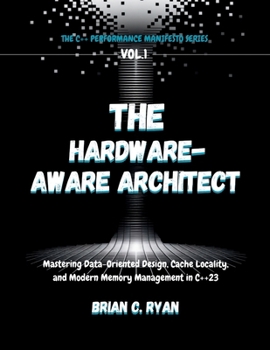
The Hardware-Aware Architect: Mastering Data-Oriented Design, Cache Locality, and Modern Memory Management in C++23

Modern C++ is faster than ever, so why is your software still hitting a performance wall?
The truth is that most developers are taught to prioritize "clean abstractions" over physical reality. But the CPU doesn't care about your design patterns; it cares about cache lines, memory latency, and branch prediction. In the world of High-Frequency Trading (HFT), AAA gaming, and AI infrastructure, the distance between your code and the hardware is the difference between a system that dominates and a system that fails.
The Hardware-Aware Architect is your definitive blueprint for Mechanical Sympathy.In this first volume of The C++ Performance Manifesto, you will strip away the "black box" of the modern machine. This isn't just a book about syntax; it is a visual masterclass in Systems Engineering that teaches you to see memory as a physical landscape.
Inside this Edition, you will master:
The Memory Wall: Why CPU-RAM divergence is the #1 killer of performance, and how to bypass it.
Data-Oriented Design (DOD): Shifting from "Object-Oriented Bloat" to high-throughput Struct-of-Arrays (SoA) layouts.
The 64-Byte Fetch: How to exploit spatial locality to ensure your cache is never empty.
C++23 Zero-Copy APIs: Leveraging std:: span and std:: string_view to eliminate expensive heap allocations.
Branch Prediction Mastery: Writing "pipeline-friendly" code that keeps the instruction stream moving at light speed.
Why This Book is Different:Visual-First Learning: Anchored by Extra Bold Architectural Diagrams that provide a "profound" understanding of complex hardware bottlenecks at a single glance.
Zero Legacy Fluff: Built specifically for C++23 and C++26, focusing on the modern features that actually matter for 2026 hardware.
HFT-Grade Strategies: Implements the same battle-tested techniques used by elite engineers to squeeze every nanosecond out of the processor.
The machine has no secrets. It only has rules. If you want to join the top 1% of developers who truly understand execution, you need to stop guessing and start measuring.
Master the hardware. Own the performance. Become the Architect.Customer Reviews
ThriftBooks ® and the ThriftBooks ® logo are registered trademarks of Thrift Books Global, LLC
