


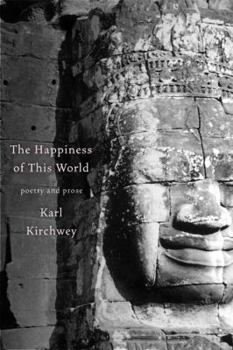
The Happiness of this World


It is this "shockability" that informs Karl Kirchwey's new work. Through four collections, he has explored the resonances between past and present, seeking a sense of home in a world of losses. Now, as the horrors of the modern world crowd in on him, he meditates on the future his children will inherit. These are angry poems, tender poems, poems of hope, love, and despair. Reviewing Kirchwey's last book in The New Criterion , William Logan wrote: "An elegy for an uncle, a World War II pilot killed in the Pacific, reminds us that we live only by the sacrifice of the dead, and therefore in their shadows. Shadows fall frequently over these poems, from lives corrupted, crippled, or destroyed," and in the concluding section of this new work, a prose memoir with poems that will appear in full in Parnassus , the poet revisits that dead uncle and the unhappy generations preceding his own. Seeking out family origins and family secrets, this section climaxes in a holy Hindu pilgrimage in honor of the dead and returns the poet, who in his search has circled the globe, to the family of the living and the circumscribed happiness of this world.
Format:Hardcover
Language:English
ISBN:0399153659
ISBN13:9780399153655
Release Date:January 2007
Publisher:Putnam Adult
Length:128 Pages
Weight:0.57 lbs.
Dimensions:8.5" x 0.7" x 5.8"
Age Range:18 years and up
Grade Range:Grade 12 and higher
Customer Reviews
2 ratings
Eloquent, understated introspection
Published by Thriftbooks.com User , 18 years ago
Karl Kirchwey's best poems do a thought-provoking job of enhancing things by placing them next to each other and letting us notice how differences grow into linkages. I am especially fond of "Reading Akhmatova", in which a child's speech therapy runs through a book of the Russian poet's far-from-childish words and themes. We adults hear things in Akhmatova -- this poem has a literariness that seems typical of Kirchwey's work -- that clangs against the child's innocent enunciation of the words. The "widening diction of experience" evoked here is one of those rare lines (in modern poetry) with staying power for me -- it has resonated with me for weeks. My favorite part of the book, though, is the prose memoir "A Yatra for Yama", in which the poet journeys through Asia on missions that prove interconnected in the subtle way that the best memoirists' stories do. It's instructive without being didactic, eloquent without being bombastic, and gentle without being slow. And the family story (about the namesake uncle killed in the crash of his plane during the WWII battle for Saipan) is a very compelling one. (Disclosure: I know Professor Kirchwey, who has taught some of my former students.)
Moving memoir
Published by Thriftbooks.com User , 19 years ago
I was very moved by the prose memoir, A Yatra for Yama - especially the first few sections that dealt with the author's uncle (who died in his early 20s in WWII), his father, and his grandmother. Amazing how a family's history lives with and continues to shape and affect one's personal life and outlook. In the latter sections, the journey ('yatra') made by the author to see his brother, who lives in a monastry in Northern India was no doubt a very personal one although it was difficult for me to feel the connection at times... but I loved the way it ended. We all have to define our individual spaces and destinies for ourselves. Did not get around to reading or enjoying the poems.
Copyright © 2026 Thriftbooks.com
Terms of Use | Privacy Policy | Do Not Sell/Share My Personal Information | Cookie Policy | Cookie Preferences | Accessibility Statement
ThriftBooks ® and the ThriftBooks ® logo are registered trademarks of Thrift Books Global, LLC
ThriftBooks ® and the ThriftBooks ® logo are registered trademarks of Thrift Books Global, LLC
