


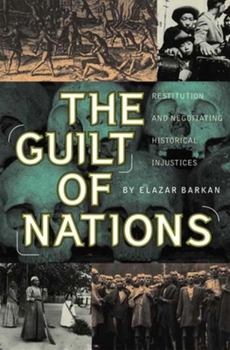
The Guilt of Nations: Restitution and Negotiating Historical Injustices


Select Format
Select Condition 
Book Overview
How do nations and aggrieved parties, in the wake of heinous crimes and horrible injustices, make amends in a way that acknowledges wrongdoing and redefines future interactions? How does the growing practice of negotiating restitution restore a sense of morality and enhance prospects for world peace? Where has restitution worked and where has it not? The Guilt of Nations explores this increasingly important dynamic in world politics today. Beyond its moral implications, restitution reflects a critical shift in political and economic bargaining. While preserving individual rights, restitution also enables victimized groups to receive growing recognition as groups . Elazar Barkan traces instances of historical crimes, such as the incarceration of Japanese Americans in the United States during World War II, the sexual abuse of comfort women by Japanese soldiers, and the recent controversy over the financial dealings between Swiss banks and Nazi Germany. He argues that, as countries including the United States, Australia, and New Zealand come to recognize past injustices toward indigenous peoples within their borders, both governments and minority groups are compelled to redress the history of colonialism and redefine national identity. While restitution is not a panacea, this ever-spreading trend represents a new moral order in world politics.
Format:Hardcover
Language:English
ISBN:0393048861
ISBN13:9780393048865
Release Date:May 2000
Publisher:W. W. Norton & Company
Length:464 Pages
Weight:0.20 lbs.
Dimensions:9.6" x 1.5" x 6.5"
Customer Reviews
1 rating
Callous disregard of the vistims
Published by Thriftbooks.com User , 25 years ago
"Those who love to feel guilty will applaud the book." How cynical! I'd have let it pass if it weren't for the "17 of 20 people (who) found the following review (by Derek Parker) helpful." Parker, like most white Australians, is totally into denial that the genocide started by invaders 213 years ago is the one and only cause for the abject state of the indigenous peoples who have not ceded sovereignty. Nine out of 10 were wiped out by slaughter, starvation, disease and dispersal from their lands. Massacres were still happening within the life spans of present-day parents and grandparents. Indigenous Australians live 20 years less on average than other people in the country. I could bore you with endless statistics testifying to the continuing devastation of Australia's First Peoples through the ongoing white war on them: deprival of education, health care, jobs, 20 times the normal imprisonment rate, etc., etc. What Parker obviously doesn't like is that the tyranny of distance no longer works and White Australia's crimes are more and more in the world spotlight, including in this book. Australia is getting plenty of stick in international bodies for not living up to human rights agreements it has signed up to. The issue is if not the biggest, then one of the biggest on the national agenda. Parker and his camp would be yelling loudest if present-day Germans were to shirk their responsibility for restitution to the Jews. Yet to him Australian perpetrators are sacrosanct. Parker alleges that "Barkan acts as if there are no difficult questions at all" in regard to the Aborigines, and "Largely, he accepts the claims put forward by the wronged group, dismissing contrary arguments." I would like Parker to back his claims that Barkan's "selection of evidence seems so one-sided as to almost be misleading" and that he's made a "number of straightforward errors." In my view, Barkan, as a non-Australian, has a remarkably accurate take on our country. "He seems to assume that the fact that someone has been wronged makes anything they say automatically correct." - Barkan does not. To speak of a "victim/victimiser methodology" is callous disregard of the pain our indigenous people still suffer and a vicious panning of those who empathize with them. "There are important issues of human dignity here." - You bet! Yet the Australian government is refusing to allow various United Nations human rights sub-bodies into the country to investigate. "How much responsibility can be placed on the shoulders of people who might well have been ignorant, or even born after, the wrongdoing?" - So we don't attone or restitute in any way once our parents and grandparents are no more? Tough luck for those suffering among us if our ancestors wronged theirs? If we're living off the fat of an invasion, and those invaded still suffer the after-effects? "The case he discusses where, in Australia in the 1960s, half-caste Aboriginal children were removed from their families and placed in
Copyright © 2026 Thriftbooks.com
Terms of Use | Privacy Policy | Do Not Sell/Share My Personal Information | Cookie Notice | Cookie Preferences | Accessibility Statement
ThriftBooks ® and the ThriftBooks ® logo are registered trademarks of Thrift Books Global, LLC
