


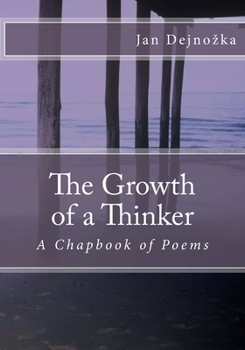
The Growth of a Thinker: A Chapbook of Poems
No Customer Reviews

"Great read " - Panayot Butchvarov. "The poems look great " - Paul C. Nascimbene. This chapbook of poems shows the growth of a thinker over a period of forty years. It contains most of the poems the author has written. The main subjects are philosophy, religion, and mythology. There are poems about love, karma, realization, death, rebirth, different religions and deities, and mysticism. The last two poems are the ones of primary philosophical interest. They explore and offer a unified theory of more technical topics such as perception and evidence, universals and particulars, being and nothingness, essence and accident, reality and illusion, ontology and metaphysics, ethics and aesthetics, justice and mercy, and personal and impersonal ultimate spiritual reality. In "Karma" (22 pages), I put the karmic thesis through its paces and find it wanting on every level. I examine karma from the standpoint of metaphysics, epistemology, and ethics. I discuss: whether the alleged law of karma is descriptive of causal fact or prescriptive of an ethical norm, whether punitive karmic justice is better than religious mercy; whether karma is based on reason or an article of faith; whether karma is an intellectual theory or a practical working maxim; whether karma is a universal truth ("universal" means without exception) or a merely general truth ("general" means true in most cases, or at least in many cases, or at least sometimes); whether the ontological locus of karma is in reality or in Maya, the world-illusion; whether karma is a vehicle, bridge, or ladder from the world of illusion to the world of reality, or even to a mystical nirvana that is beyond good and evil, and whether it is to be dropped or set aside upon arrival at the destination; and the karmic rule of conduct versus the Golden Rule of conduct (the two rules are very different). In the last stanza, I suggest that the ontological locus of karma is in the human condition, where it is only approximately true, and is probably Darwinian in origin, that is, probably exists in human actions and reactions to the extent it does because it promotes species survival, that is, amounts to nothing more than our collective tendency to reward helpful behavior and punish harmful behavior. Beyond that, I reject karma as a myth. In the last poem, "The Real and the relative," I summarize my own ontology with respect to the topics mentioned in the poem's title.
Format:Paperback
Language:English
ISBN:1468183834
ISBN13:9781468183832
Release Date:March 2012
Publisher:Createspace Independent Publishing Platform
Length:84 Pages
Weight:0.36 lbs.
Dimensions:0.2" x 7.0" x 10.0"
Related Subjects
PoetryCustomer Reviews
0 rating
Copyright © 2026 Thriftbooks.com Terms of Use
| Privacy Policy | Do Not
Sell/Share My Personal Information | Cookie Policy | Cookie Preferences | Accessibility Statement
ThriftBooks® and the ThriftBooks® logo are registered trademarks of Thrift Books Global, LLC
ThriftBooks® and the ThriftBooks® logo are registered trademarks of Thrift Books Global, LLC
