


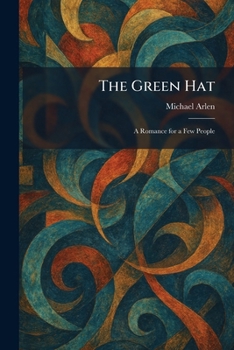
The Green Hat: A Romance for a Few People

Select Format
Select Condition 
Book Overview
"The Green Hat" is a seminal work of the 1920s that captures the cynical elegance and restless spirit of the Jazz Age. Set against the backdrop of post-war London high society, Michael Arlen's most famous novel follows the enigmatic Iris March, a woman of striking beauty and questionable reputation who navigates a world of privilege, scandal, and unspoken desires. Known for her defiant independence and her trademark green felt hat, Iris becomes the center of a tragic web of love and social expectation.
This "Romance for a Few People" explores the complex morality and disillusionment of the British aristocracy in the wake of the Great War. Through sharp dialogue and atmospheric prose, Arlen depicts a generation struggling to find meaning amidst hedonism and heartbreak. The narrative weaves together themes of loyalty, betrayal, and the rigid constraints of class, culminating in a powerful exploration of the human heart's vulnerabilities.
As a cultural phenomenon of its time, "The Green Hat" remains a definitive portrait of the "Lost Generation." It offers readers a sophisticated blend of social satire and poignant drama, cementing its place as a classic of early twentieth-century literature. Its portrayal of the modern woman and the shifting values of the 1920s continues to resonate with those interested in the intersections of romance and societal transformation.
This work has been selected by scholars as being culturally important, and is part of the knowledge base of civilization as we know it. This work was reproduced from the original artifact, and remains as true to the original work as possible. Therefore, you may see the original copyright references, library stamps (as most of these works have been housed in our most important libraries around the world), and other notations in the work.
This work is in the public domain in the United States of America, and possibly other nations. Within the United States, you may freely copy and distribute this work, as no entity (individual or corporate) has a copyright on the body of the work.
As a reproduction of a historical artifact, this work may contain missing or blurred pages, poor pictures, errant marks, etc. Scholars believe, and we concur, that this work is important enough to be preserved, reproduced, and made generally available to the public. We appreciate your support of the preservation process, and thank you for being an important part of keeping this knowledge alive and relevant.
Customer Reviews
ThriftBooks ® and the ThriftBooks ® logo are registered trademarks of Thrift Books Global, LLC
