


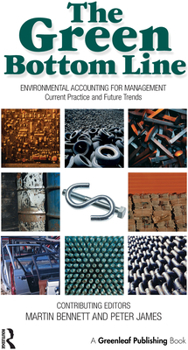
The Green Bottom Line: Environmental Accounting for Management: Current Practice and Future Trends
No Customer Reviews

Select Format
Select Condition 
Book Overview
To date, both internal and external corporate environmental reporting and management systems have focused on physical input-output measures. However, external stakeholders are increasingly demanding that organisations provide more financial information about the costs and benefits of their environmental actions. As environmental costs rise, internal decision-makers are also seeking such information to ensure that money is well spent. Beyond basic compliance, many companies will not countenance environmental actions for which a "business case" cannot be made. A number of companies - such as Baxter, BT, Xerox, Zeneca and others - are now beginning to develop a better understanding of the costs and benefits of environmental action. The US Environmental Protection Agency has also done considerable work on models designed to understand the "full costs" of pollution control investments, with the aim of demonstrating that - when these are properly considered - pollution prevention can be a more cost-effective alternative. The Green Bottom Line brings together much of the world's leading research and best-practice case studies on the topic. Divided into four sections, covering "General Concepts", "Empirical Studies", "Case Studies" and "Implementation", the book includes case studies from the US EPA's Environment Accounting Programme and contributions from authors at institutions including the IMD, INSEAD, Tellus Institute and the World Resources Institute. It constitutes a state-of-the-art collection.
Format:Hardcover
Language:English
ISBN:1874719071
ISBN13:9781874719076
Release Date:September 1998
Publisher:Routledge
Length:432 Pages
Weight:1.72 lbs.
Dimensions:1.1" x 6.3" x 9.3"
Customer Reviews
0 rating
Copyright © 2026 Thriftbooks.com Terms of Use
| Privacy Policy | Do Not
Sell/Share My Personal Information | Cookie Policy | Cookie Preferences | Accessibility Statement
ThriftBooks® and the ThriftBooks® logo are registered trademarks of Thrift Books Global, LLC
ThriftBooks® and the ThriftBooks® logo are registered trademarks of Thrift Books Global, LLC
