


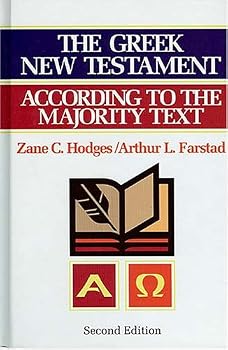
The Greek New Testament According to Majority Text (English and Greek Edition)

English summary: The relationship of art to physical violence in European cultural history has always been intricate. Aestheticised violence in the fine arts, on the stage or in literature has often... This description may be from another edition of this product.
Format:Hardcover
Language:English
ISBN:0840749635
ISBN13:9780840749635
Release Date:January 1985
Publisher:Nelson Reference & Electronic Pub
Length:810 Pages
Weight:1.85 lbs.
Dimensions:8.0" x 1.5" x 5.3"
Customer Reviews
5 ratings
offers some nice alternatives to UBS/NA
Published by Thriftbooks.com User , 18 years ago
This book gives you some nice alternatives to the UBS/NA Greek NT texts, which have developed a type of undeserved monopoly. The argument that the Egyptian texts are to be prefered over the Byzantine texts, whatever be its merits, loses its force when you have a complete text of the later, and variant readers of the former. Then when you see each variant from UBS-NA relegated to a footnote (and note that UBS/NA does NOT return the favor to the Byzantine text; UBS, especially, and even NA just give you SOME of the readings from the Byzantine text)you are struck with the fact that these readings usually give you no reason to dismiss as likely to be secondary. It's all so subjective; who is to say which reading is "more difficult" or "smoother." And of course, most of the time the variants are so minor you wonder what all the fuss is about it. Either text is just fine; it's just an irony that UBS/NA enthusiasts are often just as fanatical as defenders of the old Textus Receptus. But what I like about this text is its external features which in many ways are better than UBS or NA. The binding on this text is much better. The font is interesting, very straight and dark and clear and bigger than any but the large print editions of UBS/NA. The editors of this text say their straight font (O how we despise especially the italicized font of UBS 4, but even NA is unnecessarily sloped) is particulary easier for new readers. I don't know about that, but I like reading this font for some reason. The pages of this book are also white which is nicer than the yellow of UBS/NA. This text also does some things with puncuation which if you think about it make perfect sense. It capitalizes the first word of every sentence as we do in English. It uses regular English question marks and occasionally uses exclamation marks. This makes reading a little easier in my opinion. It also capitalizes works like Pneuma. One naturally compares this book not only to UBS/NA (and I am not saying this book is necessarily better; just different) but to Robinson and Pierpont's "The New Testament in the Original Greek," which gives a very similar Byzantine text (see my review of that book.) Both editions are great. The font on Robinson's book is a better, the best Greek font available on any edition. The critical apparatus of this book is more complete but harder to figure out than Robinson's. This book is a little more portable, and the font is only a tiny bit smaller. This book, unlike Robinson's has nice English subheadings to each section, which help a bit with reading comprehension. The introductions to neither book, in my opinion, makes the case for Byzantine priority in a clear enough way. This book does not have a ribbon; Robinson's does. This book, because of the complexity of its apparatus, has a text which is more mared with symbols; Robinson's is pure text. I guess I have to give Robinson's text a slight edge, but I really like the readab
Newer version soon to be available
Published by Thriftbooks.com User , 19 years ago
This is a fine book, but for those interested in an interlinear version, "The Majority Text Greek New Testament Interlinear" by the same editors is to be released in April, 07 by Thomas Nelson.
A Must-Have
Published by Thriftbooks.com User , 25 years ago
I own the second edition of this book, which is apparently currently out of print. I am hoping that a new edition is the works, and so thought I would give a review. This book is a real boon to New Testament scholarship. It is a revival of scholarly lines of thinking that have lost popularity in the last centuries. Since time immemorial, the method of finding out whether a particular Greek manuscript contained an accurate rendering of the originals written by the apostles and their associates was to compare it against the majority of available Greek manuscripts (called 'witnesses' because they testify to what the original might have been). If you have a manuscript that said that Jesus walked on honey and a thousand others that said that he walked on water, then your manuscript is incorrect. The reason for this thinking is two-fold. First, on a mundane level, good quality manuscripts will tend to be used as sources for others, while bad quality manuscripts tend to get thrown by the wayside. The second, spiritual reasoning, is that God providentially preserves his written Word, so God will protect good manuscripts and cause them to be copied reliably. God will let the bad manuscripts fall into obscurity. So this was the thinking of the midieval and reformation scholars. This thinking also created the famous "Textus Receptus" which was used as a basis for the New Testament of the King James Version.In the last century, European scholarship began to apply critical thinking to how manuscripts were transmitted and came up with some new ideas. They thought completely from a humanistic standpoint, that is, they didn't consider God's role in preservation of scripture at all. In addition, they gave weight to the idea that errors accumulate over time, and therefore older manuscripts are better than newer ones. That is, If you have a manuscript that says Jesus walked on honey, and a thousand others that say he walked on water, but the one that says he walked on honey is older, then it is probably correct, and the others are based on later manuscripts in to which errors have crept over time.It just so happens that this is the state of New Testament textual criticism. We have thousands of newer manuscripts that tend to resemble each other and a few really old ones that are a little different, and tend to resemble each other.The most popular Greek texts used by modern scholars are the Novum Testamentum Graece, which is based on the critical method, and the Textus Receptus, which is based on the majority method. Unfortunately, the Receptus is from the 16th century, and has a number of readings that are not majority readings because the compilers of the text had limited information available to them. So it came to pass that anyone 'scholarly' believed in the critical text, and only bumpkin preachers used the Receptus.Lately, however, the theories used by the critical scholars have come under some serious fire. The critical text scholars proposed a theory for why
English book names and chapter subtitles a key feature
Published by Thriftbooks.com User , 26 years ago
When I began to study New Testament Greek, I of course needed a good Greek New Testament. The majority text edition not only provided a durable hard cover, a great introduction, the text, and two sets of apparatus to indicate all of the variant readings, but it also had a key feature that helped me to choose it over the other available options - the book names and chapter subtitles (such as "The Rich Young Ruler", etc.) are rendered in English. This feature makes it much faster to to locate specific passages and it increases comprehension. There is no interlinear or sidebar translation, so the reader must still produce his own translation, which is what you want if you are a student. But since getting to the right place can be half the battle, this edition is a great time saver.
The best Greek New Testament available today.
Published by Thriftbooks.com User , 26 years ago
I learned an eclectic approach to textual criticism at Dallas Seminary. Then, during my doctoral work, I learned about the Majority Text position and became convinced it is correct.Whether one agrees with the Majority Text theory or not, this is an extremely well laid out Greek New Testament. It is easy to read. The textual apparatus is easy to follow. The fact that it is hardback makes it more durable than UBS or NA. I highly recommend this book. Bob Wilkin, Ph.D. Author of Confident in Christ: Living by Faith Really Works
Copyright © 2026 Thriftbooks.com
Terms of Use | Privacy Policy | Do Not Sell/Share My Personal Information | Cookie Notice | Cookie Preferences | Accessibility Statement
ThriftBooks ® and the ThriftBooks ® logo are registered trademarks of Thrift Books Global, LLC
ThriftBooks ® and the ThriftBooks ® logo are registered trademarks of Thrift Books Global, LLC
