


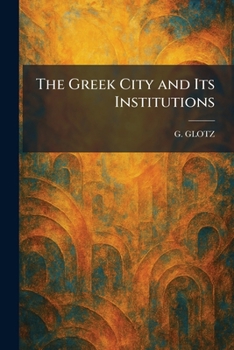
The Greek City and Its Institutions

"The Greek City and Its Institutions" provides a comprehensive and authoritative examination of the development of the city-state, or polis, in ancient Greece. Written by the renowned historian Gustave Glotz, this work traces the political, social, and economic evolution of Greek society from its tribal origins to the sophisticated urban centers of the classical period.
Glotz meticulously explores the intricate mechanisms that governed life in cities like Athens and Sparta, analyzing the transition from kinship-based organizations to democratic and oligarchic structures. The book delves into the essential institutions of the Greek world, including the assembly, the councils, and the judiciary, while also considering the role of religion and law in shaping the civic identity of the Greek citizen.
A cornerstone of classical scholarship, "The Greek City and Its Institutions" remains an essential resource for understanding the foundations of Western political thought and the unique historical conditions that allowed the Greek city to become a cradle of civilization. Glotz's masterful synthesis of historical data and sociological insights offers a vivid portrait of the ancient world's most influential political form.
This work has been selected by scholars as being culturally important, and is part of the knowledge base of civilization as we know it. This work was reproduced from the original artifact, and remains as true to the original work as possible. Therefore, you may see the original copyright references, library stamps (as most of these works have been housed in our most important libraries around the world), and other notations in the work.
This work is in the public domain in the United States of America, and possibly other nations. Within the United States, you may freely copy and distribute this work, as no entity (individual or corporate) has a copyright on the body of the work.
As a reproduction of a historical artifact, this work may contain missing or blurred pages, poor pictures, errant marks, etc. Scholars believe, and we concur, that this work is important enough to be preserved, reproduced, and made generally available to the public. We appreciate your support of the preservation process, and thank you for being an important part of keeping this knowledge alive and relevant.
Customer Reviews
ThriftBooks ® and the ThriftBooks ® logo are registered trademarks of Thrift Books Global, LLC
