


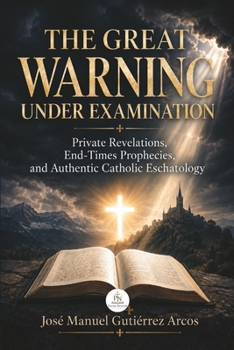
The Great Warning Under Examination

What if one of the most widely discussed prophecies in modern Catholic circles is not actually part of Catholic doctrine?
For decades, the idea of a coming Great Warning has spread through books, videos, private revelations, and Catholic prophetic circles. According to this belief, humanity will one day experience a universal illumination of conscience in which every person will suddenly see the true state of his or her soul before God.
Around this expectation, an entire prophetic framework has gradually developed: Garabandal, Russia, persecution of the Church, the Antichrist, the Three Days of Darkness, refuges, chastisements, an era of peace, and the final events of history.
But how much of this truly belongs to the Catholic faith?
In The Great Warning Under Examination, Catholic author and apologist Jos Manuel Guti rrez Arcos undertakes a rigorous investigation of the origins, development, and theological foundations of these claims.
Drawing upon Sacred Scripture, the Fathers of the Church, the Catechism, the Magisterium, historical sources, ecclesiastical documents, and the Church's criteria for discerning alleged supernatural phenomena, this book carefully separates what Catholics are required to believe from what belongs to private revelation, theological speculation, devotional tradition, or later interpretation.
The investigation examines the origins of the Great Warning at Garabandal, the meaning of public and private Revelation, biblical eschatology, the Antichrist and the final trial of the Church, the alleged Three Days of Darkness, prophetic survivalism, the supposed prophecies of Padre Pio and Saint Malachy, the role of Russia and communism, the idea of a future era of peace, and the way private revelations can gradually be combined into an alternative map of the end times.
This is not a book written to mock prophecy or deny the supernatural.
It is a book about discernment.
Can God intervene extraordinarily in history? Certainly.
But the fact that God can do something does not mean that He has revealed that He will.
With a tone that is critical without being hostile, devotional without being credulous, and deeply rooted in Catholic teaching, The Great Warning Under Examination invites the reader to rediscover the freedom that comes from placing every private revelation in its proper place.
Because Christian hope does not rest upon secret dates, hidden chronologies, or fear of the next catastrophe.
It rests upon Jesus Christ.
The Christian does not await a Warning. He awaits Christ.
Customer Reviews
ThriftBooks ® and the ThriftBooks ® logo are registered trademarks of Thrift Books Global, LLC
