


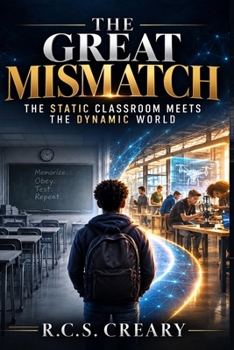
The Great Mismatch: The Static Classroom Meets the Dynamic World

The conventional classroom is built on synchronization: one bell, one path, one pace. Human learning is not.
Mass schooling solved a real problem of scale. It then mistook an administrative solution for a law of the mind. Between 1880 and 1920 the school borrowed the factory's vocabulary on purpose. Children entered as raw material. The institution processed them into a countable output. That architecture still governs most rooms. It can be scheduled, staffed, ranked, and reported. It cannot, by itself, grow judgment.
Artificial intelligence changes the constraint that once made the factory look inevitable. Individualized guidance can now be delivered at a scale one teacher cannot match. The same tool can also complete the work, erase the struggle, and leave only the appearance of competence. Personalization without an exit strategy is not education. It is a more efficient processor of the learner as product.
The Great Mismatch refuses both fantasies: that software will replace teachers, and that the old classroom should be preserved untouched. It proposes five constraints.
Scaffold, then fade.
Simulate, then touch reality.
Produce, explain, defend, and demonstrate.
Technology scales instruction; humans govern development.
The learner is not the product.
The standard is not novelty. It is independence. If the learner needs the system more after the intervention, the intervention failed. If a vendor is paid for usage rather than reduced dependence, the fifth law has already been broken. If an early score is allowed to decide who a child may become, the machine has claimed tomorrow.
This is a blueprint and a constraint document, not a claim that the full system has been proven in schools. It is written for teachers, administrators, engineers, parents, and anyone who would put AI in a classroom and still mean the word education.
Build one workshop. Measure what remains when the co-pilot goes quiet.
Customer Reviews
ThriftBooks ® and the ThriftBooks ® logo are registered trademarks of Thrift Books Global, LLC
