


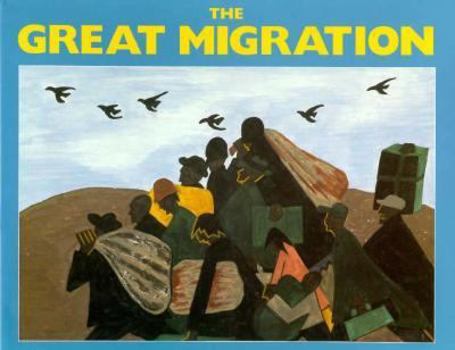
The Great Migration: An American Story

Select Format
Select Condition 
Book Overview
This critically acclaimed picture book suitable for a wide range of readers chronicles the Great Migration--the diaspora of African Americans who headed to the North after WWI--through the iconic... This description may be from another edition of this product.
Format:Hardcover
Language:English
ISBN:0060230371
ISBN13:9780060230371
Release Date:January 1
Publisher:HarperCollins Publishers
Length:48 Pages
Weight:1.15 lbs.
Dimensions:0.5" x 11.4" x 9.3"
Age Range:8 to 12 years
Grade Range:Grades 3 to 7
Customer Reviews
2 ratings
Art-lovers for life
Published by Thriftbooks.com User , 24 years ago
Parents hoping to introduce their children to modern American art could do worse than to buy this edition reproducing 60 paintings by Jacob Lawrence (1917-2000), one of the finest African American artists in U.S. history. First published for children in a 1993 limited edition, with a poem by Walter Dean Myers, this volume reproduces the Great Migration series that Lawrence created in 1940 and 1941 to tell the story of the African American migration north, from the plantations and cotton fields of the antebellum era. Begun within a year after Lawrence completed a magnificent Harriet Tubman series, these tempura colored, poster paint works made Jacob Lawrence's career. It's easy to see why. Bold and unforgiving, these vibrant works grew from Lawrence's own childhood migration--from Atlantic City, New Jersey to Easton, Pennsylvania, to Philadelphia and finally, at 13, to Harlem--his exposure to African-American culture and his intensive training in the Utopia Children's House and New Deal-sponsored Harlem Art Workshop of the 1930s. At that time, the WPA was still funding public art murals, but Lawrence was too young to gain a commission. Instead, he determined to show the African-American struggle for freedom in real-life stories that would tie the past to the present.From 1938 to 1941, he used the New York public library for research, creating in swift succession five series of paintings telling the stories of Toussaint L'Ouverture, Tubman, Frederick Douglass, John Brown, and The Migration of the Negro.In the last of these, Lawrence hoped to speak artistically of a mass escape from the rural, discriminatory and unjust South--a region of poverty and illiteracy--into an anxious era of hope and expectation in the North. The paintings depicted passage, with railways, train cars, suitcases, and hordes of people constantly in motion. Their visages and body language spoke in terms of expectation and fear. Lawrence wove bold colors and themes throughout the series, thereby joining the paintings into a unit.In a documentary shown in a museum tour of Lawrence's work, the artist said he "didn't think in terms of history in that series. ...It was like I was doing a portrait of something." Portraits were "a portrait of myself, a portrait of my family, a portrait of my peers." Lawrence's extraordinary talent was recognized when he was only 24, with the 1941 exhibition of these paintings in the downtown gallery of art dealer Edith Halpert, who had beforehand exclusively shown the work of white artists. So breathtaking were the paintings (as they remain), they instantly transported Lawrence across the U.S. racial divide of that era, making him deservedly famous. The Philips Gallery in Washington D.C. purchased the odd-numbered paintings; the Museum of Modern Art in New York took the even ones. Treat your kids to this triumph of the human spirit, and to the fine accompanying Myers poem. These paintings make children into art-lovers, for life. Alyssa A. Lappen
A pleasure to read and a pleasure to see.
Published by Thriftbooks.com User , 26 years ago
I checked this book out from the library over a year ago and knew from the illustration that Jacob Lawrence was a special person. I was drawn to the illustration because it is soothing. His illustration style is flat, yet there is a world of depth. It is the kind of art that I could have on my wall and never tire of. I remember more the art than the story. The art told a story. This book is as much for adults as it is for children. Since hearing that Jacob Lawrence died...I instantly felt the need to get one of his books for my home library.
Copyright © 2026 Thriftbooks.com
Terms of Use | Privacy Policy | Do Not Sell/Share My Personal Information | Cookie Notice | Cookie Preferences | Accessibility Statement
ThriftBooks ® and the ThriftBooks ® logo are registered trademarks of Thrift Books Global, LLC
ThriftBooks ® and the ThriftBooks ® logo are registered trademarks of Thrift Books Global, LLC
