


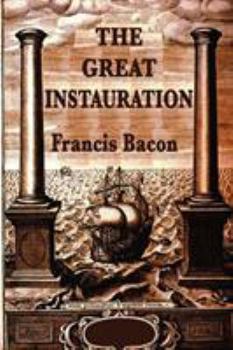
The Great Instauration: Francis Bacon's Vision for the Renewal of Science and Knowledge

Select Format
Select Condition 
Book Overview
Francis Bacon's ambitious philosophical program proposed a new foundation for knowledge based on observation, experiment, and systematic inquiry.
In The Great Instauration, Francis Bacon outlines a bold vision for the renewal of learning and the advancement of human knowledge. Rejecting reliance on inherited authorities and speculative philosophy, Bacon argues that true understanding must be built upon careful observation of nature and the disciplined use of experimental investigation.
Bacon believed that human knowledge had long been hindered by intellectual errors-what he famously called the "Idols of the Mind"-which distort judgment and prevent clear thinking. By identifying and overcoming these obstacles, scholars could establish a new method of inquiry that would gradually expand humanity's understanding of the natural world.
Originally conceived as a vast six-part project to reform the entire structure of knowledge, The Great Instauration laid the philosophical groundwork for the development of modern scientific method. Bacon's ideas profoundly influenced the intellectual culture of the seventeenth century and helped shape the scientific revolution that followed.
Customer Reviews
ThriftBooks® and the ThriftBooks® logo are registered trademarks of Thrift Books Global, LLC
