


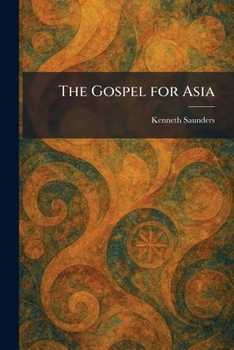
The Gospel for Asia

Select Format
Select Condition 
Book Overview
"The Gospel for Asia" is a profound exploration of the intersection between Christian theology and the vast spiritual landscapes of the East. Written by Kenneth Saunders, a noted scholar of Asian religions and missionary history, this work examines the relationship between the message of the Christian Gospels and the ancient traditions of India and Japan. Central to the text is a comparative analysis of the "Gospel of John" and its philosophical resonance with the "Bhagavad Gita" and various Buddhist scriptures.
Saunders argues for a sympathetic and scholarly approach to global mission work, seeking points of contact and fulfillment rather than conflict between disparate faiths. By analyzing the Christology of the Fourth Gospel alongside the mystical traditions of the Orient, the author presents a vision of Christianity that is both universal in scope and deeply sensitive to local cultural contexts. The book serves as a critical historical document for understanding early twentieth-century interfaith dialogue and the development of a global Christian perspective. "The Gospel for Asia" remains an essential read for students of religious history, comparative theology, and those interested in the historical evolution of cross-cultural religious exchange.
This work has been selected by scholars as being culturally important, and is part of the knowledge base of civilization as we know it. This work was reproduced from the original artifact, and remains as true to the original work as possible. Therefore, you may see the original copyright references, library stamps (as most of these works have been housed in our most important libraries around the world), and other notations in the work.
This work is in the public domain in the United States of America, and possibly other nations. Within the United States, you may freely copy and distribute this work, as no entity (individual or corporate) has a copyright on the body of the work.
As a reproduction of a historical artifact, this work may contain missing or blurred pages, poor pictures, errant marks, etc. Scholars believe, and we concur, that this work is important enough to be preserved, reproduced, and made generally available to the public. We appreciate your support of the preservation process, and thank you for being an important part of keeping this knowledge alive and relevant.
Customer Reviews
ThriftBooks® and the ThriftBooks® logo are registered trademarks of Thrift Books Global, LLC
