


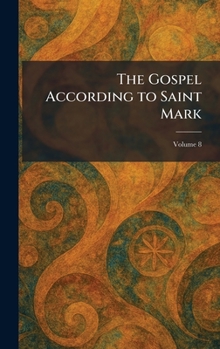
The Gospel According to Saint Mark

"The Gospel According to Saint Mark" stands as the earliest of the canonical gospels, offering a vivid and fast-paced account of the life, ministry, and passion of Jesus Christ. This work provides an in-depth exploration of the narrative, emphasizing the humanity of Jesus and the urgency of His message. Known for its concise and direct prose, the text focuses on the deeds of Jesus rather than lengthy discourses, painting a portrait of the "Suffering Servant" that has profoundly shaped Christian theology and Christology for centuries.
This scholarly treatment facilitates a deeper understanding of the Gospel's historical context, literary structure, and theological nuances. It examines the text's unique contributions to the New Testament, including its portrayal of the disciples' struggles and the messianic secret. Ideal for students of biblical studies, theologians, and readers interested in the foundations of the Christian faith, the volume preserves the integrity of the scriptural text while offering a rigorous intellectual framework. Through its exploration of Mark's distinct voice, readers gain insight into the primitive church's oral traditions and the development of early Christian literature.
This work has been selected by scholars as being culturally important, and is part of the knowledge base of civilization as we know it. This work was reproduced from the original artifact, and remains as true to the original work as possible. Therefore, you may see the original copyright references, library stamps (as most of these works have been housed in our most important libraries around the world), and other notations in the work.
This work is in the public domain in the United States of America, and possibly other nations. Within the United States, you may freely copy and distribute this work, as no entity (individual or corporate) has a copyright on the body of the work.
As a reproduction of a historical artifact, this work may contain missing or blurred pages, poor pictures, errant marks, etc. Scholars believe, and we concur, that this work is important enough to be preserved, reproduced, and made generally available to the public. We appreciate your support of the preservation process, and thank you for being an important part of keeping this knowledge alive and relevant.
Customer Reviews
ThriftBooks ® and the ThriftBooks ® logo are registered trademarks of Thrift Books Global, LLC
