


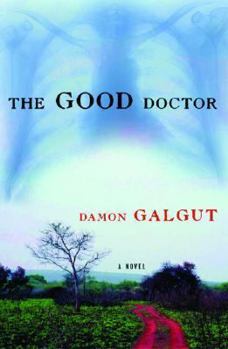
The Good Doctor


Select Format
Select Condition 
Book Overview
Taut, spare, and compellingly readable, The Good Doctor is a brilliant literary high-wire act short enough to be devoured in one or two sittings. When Laurence Waters arrives at the small rural... This description may be from another edition of this product.
Format:Paperback
Language:English
ISBN:0802117643
ISBN13:9780802117649
Release Date:January 2003
Publisher:Grove Pr
Length:224 Pages
Weight:0.85 lbs.
Dimensions:8.5" x 1.0" x 6.0"
Related Subjects
Contemporary Fiction Genre Fiction Historical Literary Literature & Fiction World LiteratureCustomer Reviews
5 ratings
Excellent : should have snazzed last year's Booker
Published by Thriftbooks.com User , 21 years ago
Damon Galgut's "The Good Doctor (GD)" is arguably the best among last year's Booker nominees, though sadly its classy but staid and measured qualities may not be what critics look for in prize winners. With GD, those acquainted with the works of South African novelists like Nadine Gordimer and J M Coetzee will find themselves in familiar territory. South Africa in transition is a perspective commonly adopted by these writers. At its highest level, the brooding tension between Frank and Laurence in their unlikely relationship is symbolic of the struggle for supremacy between the forces of old and new. When Laurence's wide-eyed enthusiasm is pitted against Frank's resigned and cynical indifference, the result is cataclysmic, far beyond the reader's imagination. While Galgut's story is touched by death and regret, his vision isn't entirely bleak. When Laurence and Frank swap beds, deadbeat after a long night out, they feel strangely comfortable in each other's beds. Like yin and yang, are they not twin halves of a pupa society emerging from its chrysalis ? Laurence's stubborn perseverance against the stultifying bureaucracy of Dr Ngema's hospital isn't always altruistic. His callous disregard for Frank's plight as he goes in frenzied pursuit of his vision of setting up a village clinic is delirious if not a little mad. In spite of this, it is Laurence who unleashes the momentum that forces Frank to examine what's wrong in his thwarted life - his failed relationships with his father, his ex-wife, Maria, etc, and who is ultimately the catalyst for Frank's transformation. There are scenes in GD that are truly memorable, like Frank's and Zanele's unexpected nocturnal encounter with the shadowy figure of the Brigadier, the town's former tinpot dictator. Surely Zanele's schoolgirl-like enchantment with her host is Galgut's sideswipe at the veneer thin and uncomprehending sloganeering of armed chaired liberals from afar. Galgut's characterisation is excellent, sharp and realised throughout. The sullenness of Tehogo, the hospital's sole unqualified male nurse, perfectly encapsulates the corruption, rot and decay of South African society. Only the rehearsed platitudes flowing from the mouth of Dr Ngema comes across as false, stagy and predictable. You know what she will say even before she says it. A minor lapse in otherwise great characterisation. Galgut's poised, unhurried and reasoned prose is an absolute delight. Its greatest strength lies in its ability to reveal many layered truths of a society at its crossroads without hyperbole or false bravura. A thoroughly confident and assured debut from Galgut, who will no doubt join the ranks of great South African novelists.
An impressive novel
Published by Thriftbooks.com User , 21 years ago
Laurence Waters is working in a rundown hospital in the capital of what used to be one of the homelands of South Africa. These areas of land are impoverished and underdeveloped, set aside by the apartheid government for the self determination of its various black nations. As Frank Eloff joins the staff of five for a one year training, he soon discovers that there is virtually no activity at the hospital. Most of the people living in the abandoned town - built once by what Laurence terms as "a puppet dictator" - aren't even aware of the presence of the facility! The equipment is so flimsy that most cases have to be referred to a hospital in a town an hour away. Nevertheless, Mr Galgut masterfully describes the relationships between the staff members, at times showing harmony, at times tension and discord. Laurence's thoughts are busy with his failed marriage, with his father resenting him for being what one may call a loser - he ironically talks about "such wonderful work you do up there amongst the rural blacks" - or with his memories of the two years he spent in the army. An altogether impressive read, atmospheric with the heavy heat of South Africa, its political and racial issues and the permanent threat of violence which many authors associate with their country in their novels - J.M. Coetzee, André Brink, Nadine Gordimer or Doris Lessing to name but a few.
Worth The Time
Published by Thriftbooks.com User , 21 years ago
"The Good Doctor" is an amazing tale of friendship, self-discovery, and dealing with the everyday struggles of a downtrodden place. This book follows Frank Eloff, a dissatisfied man who is desperately searching for change, and Laurence Waters, a young idealistic man who believes he can single handily change the world. When these two Characters meet, things begin to change for both men. Galgut shows just how much each of the men have changed the other man. In describing this relationship, Galgut holds interest by the wonderful description of the barren earth surrounding them. Galgut keeps you guessing at every twist and turn, in this impossible relationship. If you are looking to find more information on South Africa, or you just love the tale of a star-crossed friendship, then this book is most certainly for you.
worth your time
Published by Thriftbooks.com User , 22 years ago
The Good Doctor by Damon Galgut is an amazing read. I was intrigued in the first chapter and it kept my attention throughout the novel. Each sentence makes you yearn for the next, wanting and waiting to know the whole outcome. The narrator in this story, a doctor named Frank Eloff, has lost meaning behind why he's become a doctor in the first place. He becomes content with not caring and being alone until, by unwanted luck, Laurence Waters enters his life. Laurence is young, optimistic and full of energy to make a difference. He sees working at this particular hospital as the ultimate task and loves the challenge. Galgut takes you on a ride that consists of ups and downs in relationships and keeps you guessing right till the end. The movement through flashbacks and present day, what should have been and what actually was, all put together into a masterpiece of complete structure. This book is an easy read and worth every minute.
Youthful Optimism vs Middle Aged Cynicism
Published by Thriftbooks.com User , 22 years ago
Galgut's novel evokes the stark landscape of rural post-apartheid South Africa. But do not let the daunting subject matter scare you away. This is a highly accessible novel written in simple, but eloquent prose. It's told from the point of view of middle-aged Frank Eloff who is an under-achieving doctor that has spent many years of his life at a remote hospital waiting to be promoted. He begins the tale when an enthusiastic young doctor named Laurence joins the hospital as part of a required year of training. The two are required to share a room. A uncomfortable friendship blossoms. Laurence is determined to use his time at the hospital to make some radical changes as part of the new South Africa he welcomes. Frank however isn't so certain that the old South Africa has entirely left. Through the novel they are confronted by unavoidable people and problems from the past which slow the progress Laurence so ardently desires.It's a literary work that contemplates the dilemma of the new South Africa with the same brevity as Gordimer's None to Accompany Me and Coetzee's Disgrace. Apart from the political connotations, this novel is a powerful and haunting tale about friendship and a man coming to terms with his middle age. It echoes the disturbing quality of Ibsen's Ghosts through its repetition of sexual betrayal. Toward the end of Frank's narrative, his accounts become more hallucinatory and his honesty becomes uncertain. A tremendous guilt overshadows his narrative. There is a desire to shake the complacency of the environment, yet any attempt at progress instantly proves futile. This is a very melancholy novel, but one of captivating beauty and intriguing mystery.
Copyright © 2026 Thriftbooks.com
Terms of Use | Privacy Policy | Do Not Sell/Share My Personal Information | Cookie Policy | Cookie Preferences | Accessibility Statement
ThriftBooks ® and the ThriftBooks ® logo are registered trademarks of Thrift Books Global, LLC
ThriftBooks ® and the ThriftBooks ® logo are registered trademarks of Thrift Books Global, LLC
