


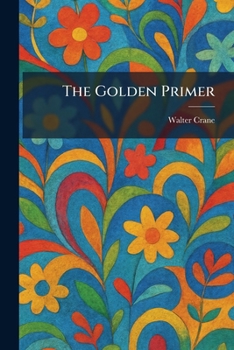
The Golden Primer

"The Golden Primer" is a beautifully illustrated educational classic designed to introduce young children to the fundamentals of reading. Created through a collaboration between Professor Meiklejohn and the renowned illustrator Walter Crane, this work represents a significant milestone in the history of Victorian pedagogy and children's literature. The book employs a methodical approach to literacy, using a phonetic system to guide early learners through the sounds and structures of the English language.
At the heart of "The Golden Primer" are the exquisite illustrations by Crane, a leading figure in the Arts and Crafts movement. His detailed and imaginative drawings do more than just decorate the pages; they serve as vital visual aids that bring the text to life, making the process of learning to read an engaging and aesthetic experience. Each page is a blend of artistic mastery and educational purpose, reflecting the era's commitment to high-quality design in children's publishing.
This work remains a testament to the idea that educational materials can be both functional and beautiful. It is an essential volume for those interested in the evolution of primary education, the history of book design, and the enduring legacy of 19th-century illustration. "The Golden Primer" continues to charm readers with its timeless appeal and its foundational role in early literacy development.
This work has been selected by scholars as being culturally important, and is part of the knowledge base of civilization as we know it. This work was reproduced from the original artifact, and remains as true to the original work as possible. Therefore, you may see the original copyright references, library stamps (as most of these works have been housed in our most important libraries around the world), and other notations in the work.
This work is in the public domain in the United States of America, and possibly other nations. Within the United States, you may freely copy and distribute this work, as no entity (individual or corporate) has a copyright on the body of the work.
As a reproduction of a historical artifact, this work may contain missing or blurred pages, poor pictures, errant marks, etc. Scholars believe, and we concur, that this work is important enough to be preserved, reproduced, and made generally available to the public. We appreciate your support of the preservation process, and thank you for being an important part of keeping this knowledge alive and relevant.
Customer Reviews
ThriftBooks ® and the ThriftBooks ® logo are registered trademarks of Thrift Books Global, LLC
