


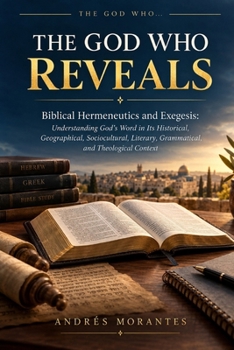
The God Who Reveals: Biblical Hermeneutics and Exegesis

Every book in this series has begun with a conviction about what its subject actually is, because the word in question has too often been worn thin by careless use. This book begins with a parallel conviction about biblical interpretation itself: that hermeneutics and exegesis are not specialized academic disciplines reserved for seminary classrooms, but essential, practical skills every serious reader of Scripture needs, whether pastor, teacher, small-group leader, or ordinary believer determined to hear God's word rightly rather than merely conveniently.
The book unfolds in six parts, each corresponding to one of the foundational dimensions careful interpretation requires. Part One establishes the theological foundation: God has genuinely revealed himself, and interpretation is the necessary, humble response that revelation demands. Part Two examines the historical, geographical, and sociocultural world behind the biblical text, the ancient world in which Scripture's authors actually lived, wrote, and were first heard. Part Three turns to the literary world within the text, the genres, structures, and compositional techniques through which the biblical authors communicated their God-given message. Part Four descends to the grammatical and linguistic detail of words, sentences, and translation, the level at which meaning is most precisely, and most easily, gained or lost. Part Five rises to the theological context within which every individual passage finds its ultimate significance, Scripture's unified story, its fulfillment in Christ, and its coherent doctrinal substance. Part Six gathers this entire method into a single, practical process moving from careful text to faithful, obedient life.
Throughout, I have tried to resist two equally tempting shortcuts. The first is a technical minimalism that treats hermeneutics as a purely academic exercise in historical and linguistic reconstruction, interesting to scholars but disconnected from genuine spiritual transformation. The second is a spiritual minimalism that treats careful method as unnecessary or even suspect, as though sincerity and prayer alone could substitute for the patient, sometimes demanding labor this book describes. Scripture itself, as Chapter 5 will argue at length, refuses this false choice: the same Ezra who devoted himself to the careful study of the Law devoted himself equally to its practice and its teaching, and the same disciples who received Christ's own risen presence still needed their minds opened before they could understand the very Scriptures they had read their whole lives.
I do not write as one who has mastered this discipline but as one still learning it, still discovering how much more patient, how much more historically informed, and how much more humble genuine understanding requires than I once assumed. My hope for this book is the same hope that has carried every volume in this series: that in learning to interpret Scripture faithfully, the reader would not merely acquire a technical skill but would fall freshly in love with the God who, across every century and in every language his people have ever spoken, has never once stopped revealing himself to those who seek him with an open heart and an examined mind.
- Andr s Morantes
Customer Reviews
ThriftBooks ® and the ThriftBooks ® logo are registered trademarks of Thrift Books Global, LLC
