


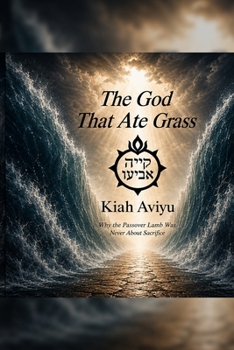
The God That Ate Grass

What if the Passover lamb was never primarily about sacrifice?
For centuries, the Exodus has been told as the story of Israel's deliverance from slavery. But hidden within the biblical text is a question that has often gone unnoticed:
Why did God command Israel to publicly take, display, and slaughter a lamb-an animal regarded as sacred in ancient Egypt?
In The God That Ate Grass, Kiah Aviyu returns to the Hebrew Scriptures to explore the Exodus through the world in which it first occurred. The result is a fresh and thought-provoking journey that reveals the Passover as more than an escape from bondage. It was a public rejection of false worship, a confrontation with fear, and the birth of a people called to freedom.
Moving from Egypt to Sinai and beyond, this book examines the deeper patterns woven throughout the Exodus:
The true significance of the Passover lamb.
Why the blood on the doorposts was a declaration before it was a sign.
How the sea, the wilderness, and the manna taught Israel to trust.
Why the Golden Calf was forged after only one day of misplaced fear.
What it means to leave Egypt without rebuilding it in the human heart.
Written in a reflective and accessible style, The God That Ate Grass invites readers to rediscover one of the world's most influential stories through the lens of the Hebrew Bible. Without attacking other traditions, it seeks to recover the original drama, beauty, and challenge of the Exodus itself.
Because the greatest miracle of the Exodus was not simply that Israel left Egypt.
It was learning how to ensure that Egypt did not remain within Israel.
Customer Reviews
ThriftBooks ® and the ThriftBooks ® logo are registered trademarks of Thrift Books Global, LLC
