


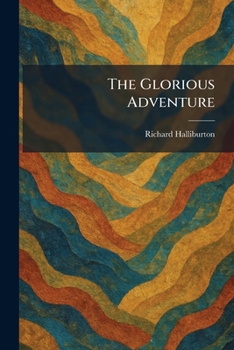
The Glorious Adventure

Select Format
Select Condition 
Book Overview
"The Glorious Adventure" is a classic work of travel literature that chronicles the daring exploits of Richard Halliburton as he attempts to retrace the legendary path of Odysseus. Setting out with boundless enthusiasm and a romantic spirit, Halliburton traverses the Mediterranean, visiting the sites immortalized in Homer's epic. From scaling the heights of Mount Olympus to swimming the Hellespont and visiting the ruins of Troy, the author brings the ancient world to life through a modern lens of discovery and physical challenge.
Written with the flair and energy that made Halliburton a household name in the early 20th century, this narrative blends historical inquiry with high-stakes adventure. The book serves as both a tribute to the classical myths of old and a testament to the enduring human desire for exploration. Readers are invited on a journey that bridges the gap between the heroic age of Greece and the adventurous spirit of the modern era, making it an essential read for enthusiasts of travelogues and Mediterranean history.
This work has been selected by scholars as being culturally important, and is part of the knowledge base of civilization as we know it. This work was reproduced from the original artifact, and remains as true to the original work as possible. Therefore, you may see the original copyright references, library stamps (as most of these works have been housed in our most important libraries around the world), and other notations in the work.
This work is in the public domain in the United States of America, and possibly other nations. Within the United States, you may freely copy and distribute this work, as no entity (individual or corporate) has a copyright on the body of the work.
As a reproduction of a historical artifact, this work may contain missing or blurred pages, poor pictures, errant marks, etc. Scholars believe, and we concur, that this work is important enough to be preserved, reproduced, and made generally available to the public. We appreciate your support of the preservation process, and thank you for being an important part of keeping this knowledge alive and relevant.
Customer Reviews
ThriftBooks ® and the ThriftBooks ® logo are registered trademarks of Thrift Books Global, LLC
