


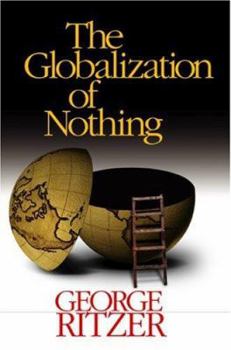
The Globalization of Nothing

Select Format
Select Condition 
Book Overview
"The Globalization of Nothing is one of the most original analyses of forces operating in the world today. Ritzer presents a new thesis--indeed a grand narrative-- on the dynamics of globalizaton. The production and distribution of "nothing" or social formations that are centrally conceived, controlled and comparatively devoid of distinctive content represents a new way to address many of the issues raised by postmodern theory (without all of the jargon and anti-science rhetoric) and world systems theory (without the hoped for collapse of capitalism). It is critical but not shrill. It forces the reader to look at the contemporary work in a new way. The book is highly readable and engaging. It has something to say to the scholar, student, and layperson."
--Jonathan Turner, University of California, Riverside
"The Globalization of Nothing is a brilliant essay that develops revolutionary ideas based on sharp, penetrating observations. This book is truly the product of a "sociological eye." I do no exaggerate when I use the term "revolutionary." The author presents a phenomenon--or set of phenomena--that stretch sociology′s phenomenological field. . . . After you become aware of nothing, you need to rethink the world and the way you look at it."
--Heran Vera, University of Florida, Gainesville
"The book makes a clear, interesting, and compelling argument and it certainly contributes to our understanding of modern culture and society."
--Celestino Fern ndez, University of Arizona
"The author does an excellent job in describing and explaining nothing, something, grobalization, glocalization, globalization, and their interrelations. Examples are drawn closely from life. They are touchable and powerfully illustrative. The discussion flows well and the text is highly readable."
--Victor N. Shaw, California State University Northridge
"The book will make a valuable contribution to literature. . . . This book continues the trajectory of McDonalization by providing a more sophisticated analytical frame to interpret globalization."
--Douglas H. Constance, Sam Houston State University
"The book′s strength is that it takes a look at the big picture and is not timid in developing a case for the nothing/something continuum and the increasing globalization of nothing. We have an insufficient number of books in sociology that take on big agendas."
--Steve Zehr, University of Southern Indiana
In a world increasingly festooned with familiar logos - from the hallmark swoosh on a designer tennis shoe to an amusement park′s infamous mouse ears - it is clear that these symbols are not merely decorative, but represent important changes in our social milieu. The proliferation of credit card offers, automated banking services, and globally recognizable brand names illustrate significant changes in the realm of social consumption: a trajectory toward a world of increasingly dehumanized services and empty places and things.
George Ritzer theorizes in his provocative new book, The Globalization of Nothing, that the "grand narrative" or social story of this period is a movement from "something" to "nothing." Building on but going beyond his renowned McDonaldization thesis, Ritzer contends that societies around the globe continue to move away from "something," defined as a social form that is generally indigenously conceived, locally controlled, and rich in distinctive content. He argues that we are moving toward "nothing" - that which is centrally controlled and conceived and relatively devoid of distinctive substance. It is in the movement toward the globalization of "nothing" that "something" is lost. More than likely, that "something" is an indigenous custom, a local store, a familiar gathering place, or simply personalized interaction. Thus, the central problem in the world today is defined as "loss amidst monumental abundance (of nothing)."
The Globalization of Nothing takes the subject of globalization in new directions, introducing terms such as "grobalization" (the growing influence of, for example, American corporations throughout the world). The key conflict in the world today is viewed as that between the grobalization of nothing and the glocalization of something. This book is structured around four sets of concepts addressing this issue: "places/non-places," "things/non-things," "people/non-people," and "services/non-services." By drawing upon salient examples from everyday life, George Ritzer invites the reader to examine the nuances of these concepts in conjunction with the paradoxes within the process of the globalization of nothing. Why is it that those who produce "nothing" for major multinational corporations often cannot afford that which they produce? Why do so many of us seem to be enraptured with our favorite brands or with our credit cards? What are the social implications of the increasing "globalization of nothing" for medicine, education, and tourism? Critical questions are raised throughout the book and the reader is compelled not only to seek answers to these questions, but to critically evaluate the questions as well as their answers.
The Globalization of Nothing is ideal as a primary or supplemental text for courses in sociology, anthropology, communication, business, and related disciplines. This book is also recommended for anyone interested in the critical study of contemporary social phenomena.
--Jonathan Turner, University of California, Riverside
"The Globalization of Nothing is a brilliant essay that develops revolutionary ideas based on sharp, penetrating observations. This book is truly the product of a "sociological eye." I do no exaggerate when I use the term "revolutionary." The author presents a phenomenon--or set of phenomena--that stretch sociology′s phenomenological field. . . . After you become aware of nothing, you need to rethink the world and the way you look at it."
--Heran Vera, University of Florida, Gainesville
"The book makes a clear, interesting, and compelling argument and it certainly contributes to our understanding of modern culture and society."
--Celestino Fern ndez, University of Arizona
"The author does an excellent job in describing and explaining nothing, something, grobalization, glocalization, globalization, and their interrelations. Examples are drawn closely from life. They are touchable and powerfully illustrative. The discussion flows well and the text is highly readable."
--Victor N. Shaw, California State University Northridge
"The book will make a valuable contribution to literature. . . . This book continues the trajectory of McDonalization by providing a more sophisticated analytical frame to interpret globalization."
--Douglas H. Constance, Sam Houston State University
"The book′s strength is that it takes a look at the big picture and is not timid in developing a case for the nothing/something continuum and the increasing globalization of nothing. We have an insufficient number of books in sociology that take on big agendas."
--Steve Zehr, University of Southern Indiana
In a world increasingly festooned with familiar logos - from the hallmark swoosh on a designer tennis shoe to an amusement park′s infamous mouse ears - it is clear that these symbols are not merely decorative, but represent important changes in our social milieu. The proliferation of credit card offers, automated banking services, and globally recognizable brand names illustrate significant changes in the realm of social consumption: a trajectory toward a world of increasingly dehumanized services and empty places and things.
George Ritzer theorizes in his provocative new book, The Globalization of Nothing, that the "grand narrative" or social story of this period is a movement from "something" to "nothing." Building on but going beyond his renowned McDonaldization thesis, Ritzer contends that societies around the globe continue to move away from "something," defined as a social form that is generally indigenously conceived, locally controlled, and rich in distinctive content. He argues that we are moving toward "nothing" - that which is centrally controlled and conceived and relatively devoid of distinctive substance. It is in the movement toward the globalization of "nothing" that "something" is lost. More than likely, that "something" is an indigenous custom, a local store, a familiar gathering place, or simply personalized interaction. Thus, the central problem in the world today is defined as "loss amidst monumental abundance (of nothing)."
The Globalization of Nothing takes the subject of globalization in new directions, introducing terms such as "grobalization" (the growing influence of, for example, American corporations throughout the world). The key conflict in the world today is viewed as that between the grobalization of nothing and the glocalization of something. This book is structured around four sets of concepts addressing this issue: "places/non-places," "things/non-things," "people/non-people," and "services/non-services." By drawing upon salient examples from everyday life, George Ritzer invites the reader to examine the nuances of these concepts in conjunction with the paradoxes within the process of the globalization of nothing. Why is it that those who produce "nothing" for major multinational corporations often cannot afford that which they produce? Why do so many of us seem to be enraptured with our favorite brands or with our credit cards? What are the social implications of the increasing "globalization of nothing" for medicine, education, and tourism? Critical questions are raised throughout the book and the reader is compelled not only to seek answers to these questions, but to critically evaluate the questions as well as their answers.
The Globalization of Nothing is ideal as a primary or supplemental text for courses in sociology, anthropology, communication, business, and related disciplines. This book is also recommended for anyone interested in the critical study of contemporary social phenomena.
Format:Paperback
Language:English
ISBN:0761988076
ISBN13:9780761988076
Release Date:July 2003
Publisher:SAGE Publications, Inc
Length:280 Pages
Weight:0.85 lbs.
Dimensions:6.0" x 0.6" x 8.9"
Customer Reviews
2 ratings
Ritzer's Best, by far
Published by Thriftbooks.com User , 22 years ago
This is a thoughtful, rich, critical, engaging analysis. I was pleasantly surprised. I had major problems with his famous McDonalization of Society -- I thought it was pretty thin, extremely redundant, and gave short-shrift to the profit motive. Furthermore, Ritzer kept re-packing the same ideas in various publications. I was jealous of all the money he was making, but not impressed in terms of scholarly innovation. When I saw this book, I thought: oh, no, here we go again: slick title, slick cover....another money maker for Ritzer and shallow analysis for us. WRONG. Even picking this book up with enormous skepticism, I was totally engaged. This is great stuff. He not only explains his observations carefully, but his analysis of WHY the trend under scrunity is happening is solid. And he gives credit where credit is due -- to Marx, in this case. Good for Ritzer. Ritzer's argument is that products, places, and services that are locally constructed, locally controlled, and full of distinct and special qualities are vanishing. What are proliferating and ever-increasing are products, places, and services that are centrally constructed, centrally controlled, and lacking distinct or special qualities. But he goes beyond this observation and really tries to EXAPLIN it. His critiques of the profit-motive are strong and right on the mark. Sure, there were many things I disagreed with in this book, and things I would take exception to. But ultimately this was solid scholarship, piercing and profound social theory, and a great leap forward for one of sociology's most productive scholars.
A philosophical and clarion warning
Published by Thriftbooks.com User , 22 years ago
The Globalization Of Nothing is an articulate economic thesis by Professor George Ritzer (University of Maryland) that articulately postulates the short and long-term effects of globalization. Claiming that societies worldwide are moving away from "something" (defined as unique and distinctive indigenous social forms), toward the "nothing" (globalized products that are centrally controlled and blandly the same worldwide), The Globalization Of Nothing warns that societies all over the world today are rapidly losing unique customs, local businesses, gathering places, even the hallmark of personal interaction. The Globalization Of Nothing is a philosophical and clarion warning regarding the creeping and homogenizing impersonality of severe economic forces.
Copyright © 2026 Thriftbooks.com
Terms of Use | Privacy Policy | Do Not Sell/Share My Personal Information | Cookie Policy | Cookie Preferences | Accessibility Statement
ThriftBooks ® and the ThriftBooks ® logo are registered trademarks of Thrift Books Global, LLC
ThriftBooks ® and the ThriftBooks ® logo are registered trademarks of Thrift Books Global, LLC
