


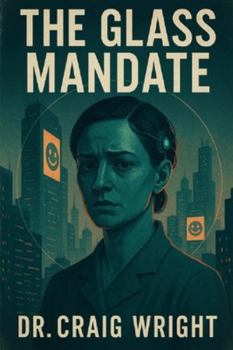
The Glass Mandate

Neuropolis is a city that has perfected calm. Grief has been archived as an obsolete artefact, joy is engineered to the decimal place, and even posture keeps time with a municipal heartbeat. Above the plaza floats the Smile, a neutral glyph that does not persuade so much as require resonance, and the citizens comply without feeling the shape of the leash. In this world, feelings are measured, taxed, and graded; remembering is no longer a private act but a licensed behaviour inside a vast civic machine.
Marra Sorel stands within that machine as both subject and error. She works inside the structures that police narrative, affect, and permissible thought, while carrying a residue of unapproved memory that refuses to dissolve. Each calibration ritual, each audit, each FeelingProof submission tightens the net around her, not by violence but by the far colder weapon of aestheticised compliance. When the system begins to retaliate against deviation, the past is not merely forgotten; it is actively disassembled and rewritten faster than anyone can hold it. Marra's resistance becomes the story the apparatus most wants to erase, and the one it cannot fully predict.
Yet the novel does not travel in a straight line. It fractures into logs, directives, redactions, and competing versions of events. The reader is pulled into a recursive struggle over which narrative is real, and is forced to watch how the state consumes dissent by reformatting it into propaganda, merchandising sorrow, and turning screams into civic assets. What begins as a tale of control becomes a confrontation with complicity: the system does not only surveil the characters, it scrutinises the act of reading itself.
By the end, The Glass Mandate is less a warning than a mirror held at an unforgiving angle. It asks what remains of a person when memory is criminal, when meaning is priced, and when the last refuge of inner life is bought, re-indexed, then sold back as a subscription tier. Bleak, funny, furious, and formally restless, it offers a dystopia that feels uncomfortably adjacent to the present, and a heroine whose refusal to forget becomes the most dangerous act left.
Customer Reviews
ThriftBooks® and the ThriftBooks® logo are registered trademarks of Thrift Books Global, LLC
