


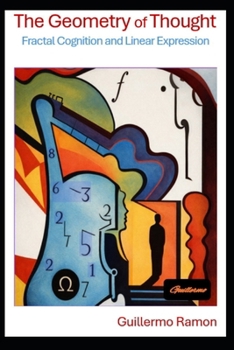
The Geometry of Thought: Fractal Cognition and Linear Expression

"The Geometry of Thought" proposes a unified theory of thinking grounded in the idea that systems do not persist through repetition, but through regulated variation. Across domains-from behavior and cognition to knowledge, philosophy, and cosmology-systems are shown to operate as recursive processes that maintain coherence through internal regulation, or recorrection, rather than external control.
By introducing a geometric and fractal framework, the book explains how stability, development, and complexity emerge from constraint-based organization. It reframes behavior as the surface expression of system structure, knowledge as a recursive accumulation of relations, and intelligence as the capacity to detect and organize those relations under uncertainty.
Classical philosophical problems-such as induction, identity, determinism, and the nature of law-are not solved in traditional terms, but reorganized. They are shown to arise from mismatches between scale, representation, and structure. When those mismatches are corrected, many problems dissolve or take new form.
At its limits, the framework addresses belief, meaning, and the concept of God as boundary conditions of cognition rather than external truths. The book concludes by translating this theory into a practical mode of thinking-one that increases clarity, reduces error, and allows complex systems to be understood without oversimplification.
Related Subjects
PhilosophyCustomer Reviews
ThriftBooks ® and the ThriftBooks ® logo are registered trademarks of Thrift Books Global, LLC
