


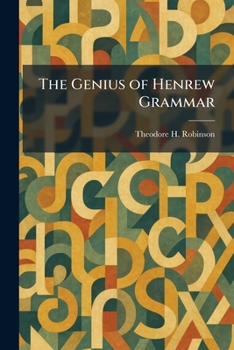
The Genius of Henrew Grammar

"The Genius of Hebrew Grammar" is a profound exploration of the structural and philosophical nuances of the Hebrew language. Written by the esteemed scholar Theodore H. Robinson, this work delves into the unique characteristics that define the linguistic framework of the language, moving beyond mere syntax and morphology to uncover the underlying spirit and logic of the tongue.
Robinson examines how the language's structure reflects the thought patterns and cultural worldview of its ancient speakers, particularly in the context of Biblical literature. By analyzing the verbal system, noun formations, and the rhythmic qualities of both prose and poetry, the author provides a comprehensive overview that serves both the student of linguistics and the serious theologian. This treatise is essential for those seeking to understand the inner workings of the Old Testament's primary language and the evolution of Semitic philology.
Through clear exposition and scholarly rigor, "The Genius of Hebrew Grammar" remains a vital resource for grasping the intricacies of one of the world's most influential liturgical and historical languages. It offers a bridge between technical grammatical analysis and a deeper appreciation for the literary artistry found within the ancient texts.
This work has been selected by scholars as being culturally important, and is part of the knowledge base of civilization as we know it. This work was reproduced from the original artifact, and remains as true to the original work as possible. Therefore, you may see the original copyright references, library stamps (as most of these works have been housed in our most important libraries around the world), and other notations in the work.
This work is in the public domain in the United States of America, and possibly other nations. Within the United States, you may freely copy and distribute this work, as no entity (individual or corporate) has a copyright on the body of the work.
As a reproduction of a historical artifact, this work may contain missing or blurred pages, poor pictures, errant marks, etc. Scholars believe, and we concur, that this work is important enough to be preserved, reproduced, and made generally available to the public. We appreciate your support of the preservation process, and thank you for being an important part of keeping this knowledge alive and relevant.
Customer Reviews
ThriftBooks ® and the ThriftBooks ® logo are registered trademarks of Thrift Books Global, LLC
