


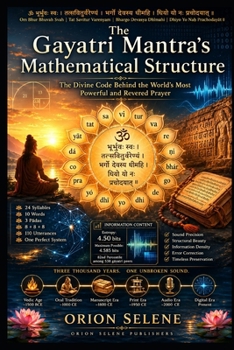
The Gayatri Mantra's Mathematical Structure: The Divine Code Behind the World's Most Powerful and Revered Prayer

What if one of the world's most revered prayers is also a masterpiece of mathematical structure and information preservation?
For thousands of years, the Gāyatrī Mantra has passed from teacher to student through the fragile medium of human memory. Twenty-four syllables. Three precisely structured pādas. An ancient prayer for the illumination of the human mind.
But beneath its apparent simplicity lies an extraordinary story of sound, mathematics, language, memory, and preservation.
In The Gayatri Mantra's Mathematical Structure: The Divine Code Behind the World's Most Powerful and Revered Prayer, Orion Selene examines the Gāyatrī through both ancient knowledge and modern analytical methods.
Beginning with the intriguing mystery of an apparently missing twenty-fourth syllable, the investigation expands into Vedic metre, the laghu-guru binary system, Piṅgala's combinatorics and meru-prastāra, Sanskrit phonology, Pāṇini's linguistic compression, information entropy, and the remarkable Vedic systems of oral recitation.
The book reveals how increasingly elaborate recitation methods-pada, krama, jaṭā, and ghana-created structured redundancy capable of protecting sacred words against omission, substitution, and changes in sequence. Viewed through the language of modern information theory, this ancient oral tradition begins to resemble an extraordinarily sophisticated error-detecting and error-resistant transmission system built entirely from human voices and memory.
Yet this is not a book of numerology.
Rather than searching for convenient mystical coincidences, the author tests the Gāyatrī against other genuine Vedic verses and clearly distinguishes what mathematics can demonstrate, what scholarship establishes, and what spiritual tradition teaches.
The result is a different understanding of the Divine Code.
The code is not a secret cipher hidden inside twenty-four syllables.
It is the magnificent architecture that carried them across millennia:
Sound. Metre. Structure. Recitation. Redundancy. Memory. Devotion.
For readers interested in Vedic wisdom, Sanskrit, mathematics, information theory, ancient Indian knowledge, mantra science, linguistics, and the history of human thought, this book offers a journey into one of civilization's most remarkable achievements-the preservation of sacred sound across three thousand years.
The metre gave it structure.
The recitation gave it protection.
Memory carried it through time.
And devotion refused to let it disappear.
Customer Reviews
ThriftBooks ® and the ThriftBooks ® logo are registered trademarks of Thrift Books Global, LLC
