


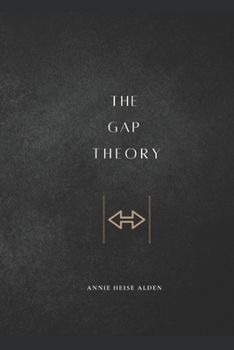
The Gap Theory

You've been asking yourself the same question for years.
You just keep dressing it up as a new one.
Gap Theory is not about healing, optimizing, or becoming your best self.
It's about something far more ordinary-and potentially far more useful:
the space between what we encounter and what we conclude.
Most of the time, we move through that space so quickly we don't notice it was there.
We see a problem and start solving it.
We hear an answer and accept it.
We encounter disagreement and start defending.
We learn something new and assume the unknown got smaller.
But what happens if we leave a little room?
Drawing from architecture, education, history, business, learning, and everyday life, Annie Heise Alden traces a cognitive pattern hiding in wildly different places-and offers a simple framework for noticing it.
Gap Theory is a philosophy of critical thinking built around a deceptively simple question: What else could be true?
Not anything could be true. Evidence still matters. Expertise matters. Reality gets a vote.
The question simply asks us not to give the first answer more weight than it has earned.
Throughout the book, Alden explores what happens when we create space between observation and interpretation, question and answer, problem and solution, knowledge and implementation. She examines why certainty and clarity are not the same thing, how learning more can reveal how much more there is to know, why disagreement can expand understanding without requiring us to meet in the middle, and what happens to human thinking in a world where answers are increasingly easy to obtain.
The goal is not endless uncertainty.
It is not to question everything forever.
And it is certainly not to stop concluding.
It is to give our conclusions a chance to get better.
Because sometimes the most useful thing we can do isn't find another answer.
It's earn a better question.
What else could be true?
Customer Reviews
ThriftBooks ® and the ThriftBooks ® logo are registered trademarks of Thrift Books Global, LLC
