


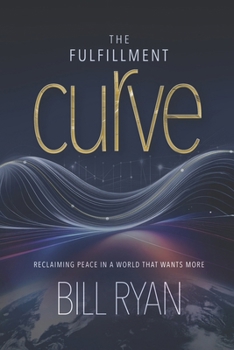
The Fulfillment Curve: Reclaiming Peace In A World That Wants More
No Customer Reviews

The Fulfillment Curve: Reclaiming Peace in a World That Wants More is a quiet reckoning with the modern obsession with achievement. And a grounded invitation to something deeper. For much of our lives, we are taught to chase: goals, status, momentum, validation. Fulfillment, we are told, will arrive later. After the next milestone, the next promotion, the next reinvention. And so, we run. Productive. Disciplined. Externally successful. Yet beneath the motion, many experience a growing sense of fatigue or misalignment that no amount of progress seems to resolve. This book begins where that realization becomes unavoidable. The Fulfillment Curve explores the subtle but decisive shift from a life organized around pursuit to one anchored in choice. Not resignation. Not withdrawal. But reorientation. Away from striving as identity and toward alignment as posture. It asks a simple but unsettling question: What if fulfillment is not something you reach, but something you recognize? Drawing from philosophy, psychology, and lived experience, the book traces a natural arc many people encounter but rarely name: the curve from ambition-driven motion to clarity-driven presence. Early chapters examine how achievement culture trains us to confuse motion with meaning, urgency with importance, and intensity with truth. Success is not the enemy. But unexamined success can quietly hollow us out. Rather than offering hacks or motivational slogans, The Fulfillment Curve slows the reader down. It replaces the language of optimization with the language of coherence. Alignment is defined not as balance or passion, but as steadiness: the felt sense of being internally undivided. The book challenges common assumptions: that clarity must precede choice, that more effort always leads to better outcomes, or that fulfillment requires reinvention. At its core, this is a book about stillness - not as escape, but as discernment. Stillness as the condition that allows truth to surface. Stillness as the moment when we stop negotiating with ourselves long enough to hear what is already known. Reflective vignettes ground these ideas in lived consequence - moments of ambition, loss, withdrawal, and recalibration - illustrating how purpose can be distorted when worth becomes contingent on performance. The second half of the book introduces a humane framework for realignment. Readers are guided through tools designed not to add more to life, but to subtract distortion: filters for decision-making, audits for misalignment, and practices for returning to center when momentum takes over. These are not systems to perfect the self, but ways to listen more clearly to it. The Fulfillment Curve ultimately reframes success itself. Fulfillment is not happiness or constant peace. It is integrity in its original sense: wholeness. A life where action no longer requires self-betrayal. Where progress does not come at the expense of presence. Where choosing replaces chasing, not because ambition has died, but because it has matured. This book is for those who have done what they were supposed to do and sensed that something essential was missing. For leaders, builders, creatives, and thinkers standing at a threshold, unsure whether to push harder or pause more honestly. The Fulfillment Curve does not tell you who to become. It invites you to stop becoming long enough to remember who you already are. And to build from there, deliberately, calmly, and whole.
Format:Paperback
Language:English
ISBN:B0GJ5932C5
ISBN13:9798994129654
Release Date:January 2026
Publisher:Liveforward Publishing
Length:264 Pages
Weight:0.79 lbs.
Dimensions:0.6" x 6.0" x 9.0"
Customer Reviews
0 rating
Copyright © 2026 Thriftbooks.com Terms of Use
| Privacy Policy | Do Not
Sell/Share My Personal Information | Cookie Policy | Cookie Preferences | Accessibility Statement
ThriftBooks® and the ThriftBooks® logo are registered trademarks of Thrift Books Global, LLC
ThriftBooks® and the ThriftBooks® logo are registered trademarks of Thrift Books Global, LLC
