


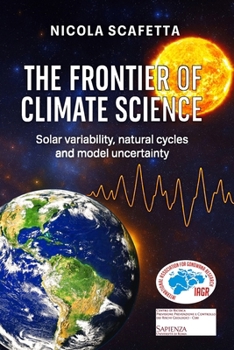
The Frontier of Climate Science: Solar variability, natural cycles and model uncertainty

How well do we truly understand Earth's climate? What natural forces remain beyond our grasp? Is Net Zero the only viable path forward? The Frontier of Climate Science explores climate dynamics through physics, complex systems, and astronomy, synthesizing several decades of peer-reviewed research.
The book critically reviews the scientific foundations of modern climate theory, the evolution of IPCC assessments, and the limits of global climate models (GCMs) when confronted with observations. It investigates natural variability across multiple timescales, including oceanic oscillations, solar variability, and astronomical cycles driving both solar and climate variability, integrating satellite data, paleoclimate reconstructions, and empirical modeling approaches.
From this evidence emerges a balanced view of climate risk, favoring pragmatic adaptation over narrowly defined policy pathways such as Net Zero. Rich in insights and analytical approaches, the book helps readers understand climate variability, assess risks, think critically, and explore key open questions in climate science.
The volume is endorsed by the International Association for Gondwana Research (IAGR) and by the Centro di Ricerca Previsione, Prevenzione e Controllo dei Rischi Geologici (CERI) at Sapienza University of Rome. It includes forewords by Prof. M. Santosh, Prof. Alberto Prestininzi, and Prof. Judith Curry. These contributions underscore the scientific relevance of the work and situate it within the broader landscape of contemporary climate research.
This work synthesizes findings from more than 650 peer-reviewed scientific papers at the frontier of climate science. By assembling such an extensive body of evidence, the book serves as an authoritative reference for academic libraries, research institutions, and scholars seeking a rigorous, data-driven examination of climate variability and model uncertainty. Its comprehensive scope and methodological clarity make it a valuable resource for researchers evaluating the strengths and limitations of current climate models, for instructors designing advanced curricula, and for institutions aiming to expand their collections in Earth-system sciences. At the same time, the book remains accessible to informed general readers who wish to deepen their understanding of climate dynamics, natural variability, and the scientific debates shaping contemporary climate research.
Customer Reviews
ThriftBooks ® and the ThriftBooks ® logo are registered trademarks of Thrift Books Global, LLC
