


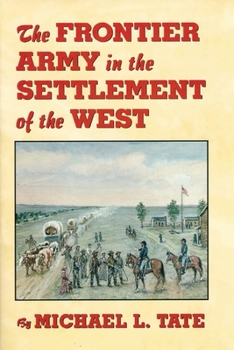
The Frontier Army in the Settlement of the West

Select Format
Select Condition 
Book Overview
Books, art, and movies most often portray the frontier army in continuous conflict with Native Americans. In truth, the army spent only a small part of its frontier duty fighting Indians; as the main... This description may be from another edition of this product.
Format:Hardcover
Language:English
ISBN:080613173X
ISBN13:9780806131733
Release Date:November 1999
Publisher:University of Oklahoma Press
Length:454 Pages
Weight:1.77 lbs.
Dimensions:1.4" x 6.3" x 9.3"
Customer Reviews
4 ratings
How the West was really won
Published by Thriftbooks.com User , 17 years ago
This was required reading for a graduate course in the history of American military affairs. Tate's well written and informative book The Frontier Army In The Settlement Of The West, accomplished his stated goal of breaking the John Wayne "Hollywood" stereotype of the American frontier soldier in the nineteenth century. Using the historiographical method of "social history" as his guide and completing an exhaustive examination of primary sources such as official records, diaries, autobiographies, army posts newspapers, and secondary historical sources, Tate has brilliantly documented the multifaceted life and missions of frontier soldiers. The crux of Tate's thesis is that the frontier army's accomplishments provided a great service to the nation in not only helping to bring about the completion of "manifest destiny," but in a myriad of fields; such as, exploration, transportation, communication, meteorology, agriculture, medicine, conservation, and emergency relief work. Tate's book illuminated the important services the frontier army provided to the young American nation that started soon after the Lewis and Clark expedition returned in 1806 and which lasted until the close of the nineteenth century. In the early part of the nineteenth century, soldiers of the frontier army became "trailblazers" in such endeavors as exploration, surveying, cartography, road building, and in providing medical and law enforcement needs to settlers in the newly burgeoning territories. Among the plethora of tasks that the army engaged in which wound up leaving an indelible mark on America's socio-economic history, was building army posts, improving roads and providing escort service along the Santa Fe and other trails which provided ease in transportation and protection from Indians as settlers who started their migration into western territories. Later in the nineteenth and early twentieth centuries, the army provided much needed humanitarian and disaster relief services to citizens. Tate specifically elaborated on the life saving services the army provided to the city of San Francisco during the earthquake of 1906. Tate noted that these nonmilitary tasks the army became involved in were a cause of concern for many political officials, because these tasks were perceived as taking the soldiers away from their traditional military training regimen. However, when Secretary of War, John C. Calhoun, was questioned about soldiers spending so much time performing nonmilitary duties by congress in 1819, this reader understood that Calhoun's answer actually paved the way for the frontier army to be used as a tool of socio-economic change in the nineteenth century. As Tate noted Calhoun, "...tied military and civilian needs under the common banner when he noted that `the road or canal can scarcely be designated, which is highly useful for military operations, that is not equally required for the industry and political prosperity of community'" (53). Tate's bo
History Is Never Simple, Always Complex; Tate Masters the Complexity of the Frontier Army
Published by Thriftbooks.com User , 19 years ago
In reading Western military history, it is so easy to just focus on battles and campaigns, forgetting that most of the time the various infantry and cavalry companies stationed on the frontier were engaged in other pursuits. Tate presents a balanced view of the multifacted frontier army and its various activities, including raising crops to help feed enlisted men, meteorological observations, improving Western transport and communications, protecting National Parks, guarding Indians from white civilains and each other, accompanying exploreers and scientists, the impact of post chapels, schools and libraries, the list goes on as browsing the table of contents will show. Each chapter in the book deals with a differnet aspect of what the frontier army did beyond military campaigns and how that worked, intentionally or not, towards the settlement of the West. In fact, you can almost approach this book as a collection of essays on the fronier army. One thing you won't find is the worn out and untruthful profile of the frontier army as heartless killers of Indians. I found the most interesting chapter dealt with frontier army literature,covering everything from the the now exceedingly rare copies of fort newspapers to the literary fiction of Charles King, that is still read today.This book marks an important milestone in the historiography of the frontier army and makes a good companion to Edward Coffman's classic THE OLD ARMY, although Coffman's work covers the late 18th century up to the Spanish-American War.
A Must Purchase for Frontier, U.S. military enthusiasts
Published by Thriftbooks.com User , 24 years ago
I am a Russian-Soviet history specialist. But this era of America's military history is shrouded with inaccuracies and myths and this book does an excellent job of clearing up past questionable material. The author did an excellent job in showing that the U.S. Frontier army did more than chase down Indians to murder and kill them thereby opening up and keeping the frontier safe for the influx of European settlers. The author does a great job of showing that many military officers and enlisted men actually defended the Indians. This will certainly be news for many people who think that the army only tried to kill the Indians. The army posts were a hub of activity concerning domestic duties duties like farming, cleaning, maintanence of equipment and the like. This author did an outstanding job and since this is not my area of specialty, I learned quite a bit from this work. I would strongly recommend this work to anyone interested in the frontier army, its role in the post and outside the post and how that interaction actually took place. This is a must have for any living historian of the frontier era. My compliments to the author on his thorough research and lucid writing style which makes it easy to read, even for a dyslexic like myself.
Tate is awsome
Published by Thriftbooks.com User , 25 years ago
Michael Tate was my history professor at the University of Nebraska, as I found his lectures fascinating, I decided to buy his book. Anyone on any level will not only enjoy this book, but learn a lot as well. Dont pass this book up, add it to your cart now!
Copyright © 2026 Thriftbooks.com Terms of Use
| Privacy Policy | Do Not
Sell/Share My Personal Information | Cookie Policy | Cookie Preferences | Accessibility Statement
ThriftBooks® and the ThriftBooks® logo are registered trademarks of Thrift Books Global, LLC
ThriftBooks® and the ThriftBooks® logo are registered trademarks of Thrift Books Global, LLC
