


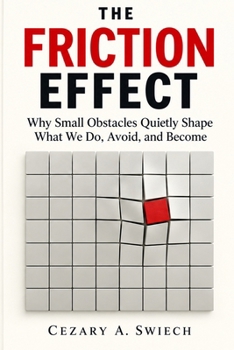
The Friction Effect: Why Small Obstacles Quietly Shape What We Do, Avoid, and Become

THE FRICTION EFFECT
Why Small Obstacles Quietly Shape What We Do, Avoid, and Become
Why do some tiny tasks go undone for weeks while other behaviors happen almost automatically?
Why do we keep scrolling when we meant to stop, buy things we did not plan to buy, postpone important conversations, or abandon goals we genuinely care about?
The answer is often not motivation.
It is friction.
In The Friction Effect, Cezary A. Swiech explores how small obstacles, defaults, convenience, and design quietly shape everyday behavior. Drawing on psychology, behavioral research, and real-world examples, he shows why even minor resistance can change what people start, continue, avoid, and repeat.
You'll discover:
why easier options often win even when they are not the ones we value mosthow companies remove friction to influence buying, watching, and engagementwhy procrastination is often about emotional and cognitive resistance, not lazinesshow defaults and automatic systems quietly steer behaviorwhy some friction is harmful while other friction protects attention, money, time, and judgmenthow to make better choices easier to enter and impulsive choices slightly harder to makewhy the goal is not a frictionless life, but better friction placementThe Friction Effect offers a new way to understand motivation, procrastination, convenience, technology, habits, decision-making, and the hidden architecture behind daily life.
Because small obstacles do not always stay small.
Repeated often enough, they can shape what we do, what we avoid-and who we become.
Customer Reviews
ThriftBooks ® and the ThriftBooks ® logo are registered trademarks of Thrift Books Global, LLC
