


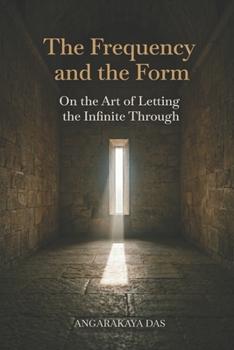
The Frequency and the Form: On the Art of Letting the Infinite Through

Two traditions, developed three thousand years and half a world apart, with no contact between them, arrived at the same account of how genuine transformation happens.
In 1581, the English mathematician John Dee began recording, in diaries that survive today in the Bodleian Library, his attempts to make contact with angelic intelligences. He called what he was doing prayer. The tradition this book sets beside it calls the same event a drop of Shruti - the eternal truth - landing in a vessel prepared to receive it.
The Vedic tradition built a precise architecture for how that landing happens: a three-thousand-year discipline of listening, reflection, and settling. The alchemists and ceremonial magicians of Europe built their own version of the same architecture and called it Solve et Coagula - dissolution followed by a higher reconstitution. Neither tradition ever read the other. Both arrived at the same sequence, down to the smallest details of what it takes to prepare a human being to receive it.
The Frequency and the Form traces that architecture through both traditions at once - not as a comparative curiosity, but as an argument: that the precise moment when something you already knew stops being information and becomes something you are has a structure, and both civilizations mapped it independently.
Drawing on Sri Aurobindo's account of the Rishis, Franz Bardon's system of ceremonial magic, the historical collaboration between John Dee and Edward Kelly, and Aldous Huxley's unlikely borrowing of Sanskrit vocabulary to describe his own Christian tradition, this book traces:
Why genuine transformation cannot be argued into being - and what can actually produce itThe three-stage discipline of Jnana Yoga (Shravana, Manana, Nididhyasana) alongside the alchemical Great Work (Nigredo, Albedo, Rubedo)What happened when a brilliant vessel met an unprepared channel - and what the Dee/Kelly working still teaches four centuries laterWhy two civilizations that never met built matching technologies not just for producing this transformation, but for telling a genuine instance of it from a counterfeit oneWhere the convergence between East and West is real - and where, honestly, it breaks down
This is not a book asking you to believe in angels, or in the cosmic nature of sound. Its claim is narrower and stranger than that: that the architecture of genuine change is something both civilizations independently mapped in exacting detail, and that the map still works.
For readers of comparative religion, Western esotericism, and Vedanta - and for anyone who has ever been changed by something they couldn't quite explain. Not by argument. By a moment in which something, finally, gave way.
Customer Reviews
ThriftBooks ® and the ThriftBooks ® logo are registered trademarks of Thrift Books Global, LLC
