


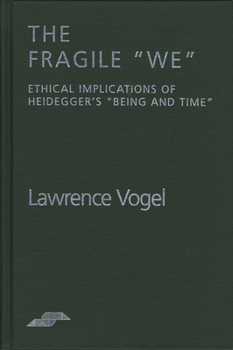
The Fragile We: Ethical Implications of Heidegger's Being and Time
No Customer Reviews

Critics have charged that Heidegger's account of authenticity is morally nihilistic, that his fundamental ontology is either egocentric or chauvinistic; and many see Heidegger's turn to Nazism in 1933 as following logically from an indifference, and even hostility, to "otherness" in the premises of his early philosophy. In The Fragile "We" Ethical Implications of Heidegger's "Being and Time," Lawrence Vogel presents three interpretations of authentic existence--the existentialist, the historicist, and the cosmopolitan--each of which is a plausible version of the personal ideal depicted in Being and Time. He then draws parallels between these interpretations and three moments in the contemporary liberal-communitarian debate over the relationship of the "I" and the "We." His book contributes both to a diagnosis of what there is about Being and Time that invites moral nihilism and to a sense of how fundamental ontology might be recast so that "the other" is accorded an appropriate place in an account of human existence.
Format:Paperback
Language:English
ISBN:0810111403
ISBN13:9780810111400
Release Date:July 1994
Publisher:Northwestern University Press
Length:140 Pages
Weight:0.55 lbs.
Dimensions:0.5" x 6.0" x 9.0"
Customer Reviews
0 rating
Copyright © 2026 Thriftbooks.com Terms of Use
| Privacy Policy | Do Not
Sell/Share My Personal Information | Cookie Policy | Cookie Preferences | Accessibility Statement
ThriftBooks® and the ThriftBooks® logo are registered trademarks of Thrift Books Global, LLC
ThriftBooks® and the ThriftBooks® logo are registered trademarks of Thrift Books Global, LLC
