


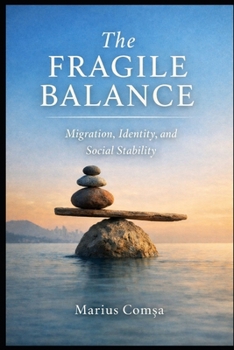
The Fragile Balance: Migration, Identity, and Social Stability

The Fragile Balance is a clear-eyed examination of one of the most difficult challenges facing modern societies: how to remain open without losing social cohesion.
In recent decades, migration-particularly forced migration-has been framed almost exclusively in moral or humanitarian terms. While compassion is essential, this book argues that moral intention alone is not enough. Societies are living systems with limits, rhythms, and internal coherence. When these limits are ignored, instability does not erupt suddenly-it accumulates quietly.
Drawing on social analysis rather than ideology, The Fragile Balance explores how unmanaged scale, weakened integration, and the erosion of reciprocity affect trust, democracy, work, welfare, and collective identity. It examines why parallel societies emerge, how tolerance without shared expectations becomes asymmetrical, and why democratic systems struggle when social cohesion declines.
This book is not written against migrants, cultures, or individuals. It is a critique of policies, assumptions, and structural failures. It asks difficult but necessary questions about capacity, responsibility, and continuity-questions often avoided in public discourse.
Written in a calm, human, and intellectually rigorous style, The Fragile Balance speaks to readers who sense that something essential is under strain but refuse simplistic explanations or inflammatory rhetoric.
This is a book for those who believe that compassion and structure are not opposites-and that preserving social stability is a prerequisite for human dignity, not its enemy.
Customer Reviews
ThriftBooks® and the ThriftBooks® logo are registered trademarks of Thrift Books Global, LLC
