


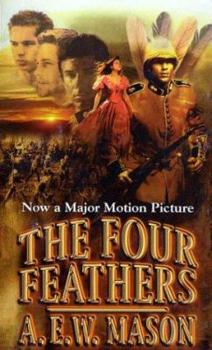
The Four Feathers

Select Format
Select Condition 
Book Overview
British guardsman Harry Feversham stuns his friends when, just before he is scheduled to ship off to the Sudan, he quits his regiment. In shocked retaliation for this dastardly act of cowardice, Harry is presented with four feathers: one from each of his three closest regimental friends and the fourth-and the most devastating-from his fiancee. Determined to prove his bravery-and to clear his name-Harry embarks for the Sudan. In search of service . . . and of honor.
Format:Mass Market Paperback
Language:English
ISBN:0765346141
ISBN13:9780765346148
Release Date:September 2002
Publisher:Tor Books
Length:320 Pages
Weight:0.35 lbs.
Dimensions:0.9" x 4.3" x 6.9"
Customer Reviews
5 ratings
The Four Feathers
Published by Thriftbooks.com User , 20 years ago
The Four Feathers by A.E.W. Mason is a riveting tale that relates the natural human need for redemption through a story that realistically depicts the complex interrelationships between love, friendships, trust, and courage. Harry Feversham, a young man who finds himself born into a historic family of proud British military men, wants nothing more than to be free of such a heritage. Whereas his forefathers fought and died with great courage, Harry is petrified of risking his life for his country and mentally labels himself a coward. Nevertheless, he has little choice but to follow in his father's footsteps. When Harry's regiment is finally summoned to go to war in the Sudan, Harry's fear of his own cowardice overcomes his fear of his father, and he accordingly resigns his commission. Once three of Harry's closest companions uncover the reason for his decision to resign, they decide to each send him a single white feather to signify his cowardice. What ensues is a story of Harry's heroic attempts at redemption, not only from his friends and from his father, but also from the girl of Harry's dreams, who, being present at the time Harry receives the feathers, adds her own to the original three. Throughout the exciting events and plot twists of The Four Feathers, Mason presents to readers a reality of human emotions and impulses which cannot draw comparison. The characters of The Four Feathers explore the complexities of humanity, loyalty, friendships, love, courage, and justice in such a fashion that each reader can relate to in his or her own individual way, making each turning of the page even more personal and captivating than the last. The three most primary characters of The Four Feathers, Harry, Ethne Eustace, and Jack Durrance, become involved in a triangle of love, loyalty, and misleading each other about how each feels about the other two in order to try and preserve these traits. Mason's novel, The Four Feathers, is highly recommended for all those seeking an exciting romantic adventure to capture their attention for hours on end. There is no question that Mason's work is one of the masterpieces of twentieth century literature.
Clean,exciting and romantic..
Published by Thriftbooks.com User , 22 years ago
My mother bought this book for me when I was a young girl-tomorrow I'll be 66 yrs old..I remember reading it over and over and even though I knew the ending, I'll could sabor the whole story like the first time--Now I'm buying for my grandchildren and hoping that they will enjoy it as much as I did.
Great story of love, courage, and friendship
Published by Thriftbooks.com User , 22 years ago
A.E.W. Mason's classic story of love lost and courage found is over a hundred years old, but its themes are timeless: love, friendship, and courage, along with the human desire to make right the wrongs of the past.Harry Feversham is a young officer in the British army whose greatest fear is to be seen a coward, and disgrace those whom he loves. On the night he finds out that he is to be sent to war in Egypt, he resigns his commission in order to avoid any possibility that his fears may be realized. In response to Feversham's act, three of his friends send him three white feathers as a symbol that in their eyes, the decision makes him a coward. When Feversham's fiancee, Ethne Eustace, finds out about Feversham's act and the three feathers, she gives Harry a fourth feather, and casts him out of her life. A broken man, Feversham quitely resolves to redeem himself by proving his bravery to each of the four, forcing each to recant their accusation of cowardice and take back the feather that each person gave.What evolves is a grand tale of adventure, as the lives of Feversham and his closest friends move along through the next few years. Ethne moves on with her life, while not entirely forgetting Feversham, nor forgiving herself for her harsh treatment of him. Harry's best friend, Jack Durrance, is blinded in the Sudan and returns to England to marry Ethne, but never forgets about Feversham, and wonders what happened to his friend. As details of Feversham's deeds begin to emerge, both Ethne and Durrance begin to understand Feversham's character; they realize their true feelings about him, and about each other.The characters in Mason's story have a Victorian simplicity, which, while limiting their outward emotions, adds to the conflict with which they have to deal. The desire to do the right thing, for love or friendship, is a strong theme in this book, which works well with the contrast between the harsh Sudan and the comforts of England; for in each location, the characters are found to suffer and survive in different ways, but in equal measure. For having been written 100 years ago, the characters and story hold up very well against modern standards. I very much enjoyed this book, and now understand why it has been made into a movie several times. The combination of intense emotion and epic adventure in far-off lands makes for some compelling reading, and a wonderful story.
I love this book
Published by Thriftbooks.com User , 23 years ago
This is a period piece, and a romantic book in every sense of the word. The "God and Country," "loyalty above all else" and strong sense of honor in the book might offend contemporary readers, but stay with it for the story of sin and redemption, loss and restoration. It's a sweeping story told in a sweeping style. It's no wonder Hollywood has made so many movie adaptations (my favorite adaptation, by the way, was the one starring Jane Seymour)!
Wonderful read
Published by Thriftbooks.com User , 24 years ago
I read this book in anticipation of the Sept. 2002 Shekar Kapur movie of the same title. I found The Four Feathers to be an engrossing character examination, with a bit of action as the background. The romance at the center was a bonus, as was the detailed glimpse of life in Britain at that time, the expectations that men and women held for one another and themselves.I was, however, disappointed by the inaccuracy in the synopsis on the book's back cover and repeated on this website which states that Harry Faversham saves the lives of the three men who gave him the white feathers in order to be redemeed.I'm not sure where the writer of the synopsis came by that idea but it sure doesn't happen like that in the book. Not to spoil the story for you, but Harry proves his bravery in rather more complex ways.I also was pleasantly surprised that much of the book is told from the perspective of Ethne, Harry's beloved. Her struggle to "do the right thing" is just as compelling as Harry's struggle to make up for the one time he didn't.
Copyright © 2026 Thriftbooks.com
Terms of Use | Privacy Policy | Do Not Sell/Share My Personal Information | Cookie Policy | Cookie Preferences | Accessibility Statement
ThriftBooks ® and the ThriftBooks ® logo are registered trademarks of Thrift Books Global, LLC
ThriftBooks ® and the ThriftBooks ® logo are registered trademarks of Thrift Books Global, LLC
