


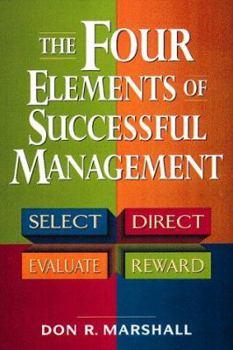
The Four Elements of Successful Management: Select, Direct, Evaluate, Reward


Select Format
Select Condition 
Book Overview
"As management trends and fads swirl around us, it's easy to lose sight of the basics. In fact, a manager's responsibilities always boil down to selecting, directing, evaluating, and rewarding people.... This description may be from another edition of this product.
Format:Hardcover
Language:English
ISBN:0814404243
ISBN13:9780814404249
Release Date:January 1998
Publisher:Amacom Books
Length:208 Pages
Weight:1.05 lbs.
Dimensions:9.8" x 1.3" x 6.5"
Customer Reviews
3 ratings
Lots of good content here
Published by Thriftbooks.com User , 19 years ago
This book does a pretty good job of covering issues relevant to operations and human resource management. It is highly structured, very well written for the most part, and full of content. I am very glad I pulled it off the shelf of my public library and read it cover to cover in a few hours. Even though I liked the book very much, I did not feel the title matched the content. I think a more apt title would have been: Strategic Planning and Getting the Most from Your Employees - A Manager's Guide. Someone who read this book before me had gone through the text with a wooden pencil and underlined a bunch of paragraphs. It actually was not all that obnoxious reading it all marked up because the marks helped break out the points being made. There were quite a few points! I recommend this book to anyone wanting to become a manager. I also recommend it to anyone interested in strategic planning. The book covers the following six points that managers must be capable of doing: 1. Understand company goals and objectives (DIRECT?) (STRATEGIC PLAN) 2. Identify jobs that will help the company meet those goals and objectives (DIRECT?) (STRATEGIC PLAN) 3. Hire or promote people to fill those jobs (SELECT) 4. Direct or coach employees to do those jobs (DIRECT) 5. Evaluate whether people hired are performing their jobs (EVALUATE) 6. Reward employees that perform and fire employees that don't (REWARD) The book's title refers to four elements of management: select, direct, evaluate, and reward. When I first read the book's title, I expected the book to talk about (1) how to hire workers, (2) how to direct or coach workers to do their jobs, (3) how to evaluate the performance of workers, and (4) how to reward or terminate workers. Each one of these questions is covered in a separate section in the book. The book is comprised of four sections. While the author does a great job answering questions 1, 3 and 4, he loses his focus when discussing question 2. Instead of telling us how to direct employees, he gets involved in the topic of strategic planning and how to relate job descriptions, goals and objectives to worker tasks. I think the book would have been better if the author had devoted an entire section (a 5th section) to strategic planning and put it at the front of the book. By doing that he could have better developed his discussion regarding question 2: How to direct or coach workers to do their jobs. After reading this book I am convinced that the author has years of experience in operations and human resource management, and is very much an expert on the subject matter. Learn from him by reading this book. It'll be a worthwhile investment of your time.
Elementary Wisdom
Published by Thriftbooks.com User , 26 years ago
The book's thesis is that four basic elements of management (Select, Direct, Evaluate, and Reward) form the "framework of all people and performance management." Throughout his book, Marshall provides what he calls "incremental lessons in understanding and applying these basic elements." At one point, he suggests that his book is directed primarily to entry-level and mid-level managers. Perhaps. But in fact, The Four Elements of Successful Management can be of substantial value to anyone who has management responsibilities (regardless of level) or who reports to those who do. Many CEOs and COOs need reminders of what they presumably have already learned but perhaps forgotten or neglected. Moreover, entry-level and mid-level managers are provided with a comprehensive frame of reference within which to understand the interdependence of the four elements. After reading Marshall's book, they will have greater respect for the complicated challenges which their own supervisors must face each day. And perhaps be better prepared to face those and/or other challenges in years to come.It is Marshall's assertion that "the reason managers spend so much time directing is that they do a poor job on selection." Direction should begin "with a strategic plan or business plan that outlines the principal products and services a business wants to produce for a specified market over a specified period of time." Throughout The Four Elements of Successful Management, Marshall shares a wealth of information and counsel. To at least some executives, perhaps, his ideas may seem obvious...if not simplistic. Be that as it may, he raises all the right questions and then provides answers which are sensible, practical, and cohesive.
Management primer full of good advice
Published by Thriftbooks.com User , 26 years ago
Don R. Marshall is president of the Marshall Group; a consulting firm that helps companies improve their quality and productivity with more than thirty years' experience in operations, HR management and performance planning. This light and enjoyable read presents how-to advice and timesaving tools for fine-tuning anyone's management skills. With an easily absorbed style, sans the usual drone of statistics or graphs, he explodes each of the title elements into distinct and definable lessons on modern reality management. I couldn't put it down. If that seems too early for such a biased endorsement, forgive my enthusiasm. Normally, a book-reviewer would parade their knowledge base against the author in a subtle battle of opinion. Not this time. The first element, "Select", is particularly useful for HR personnel or management within any size organization. Marshall correctly relates that hiring and retaining top performing people is crucial to business success, therefore the level of strategic planning to address that objective is a measure of business potential. He guides the reader in the selection process with a range of practices beginning with expected axioms such as "defining the job before trying to find a candidate" through more elaborate and sadly, less frequently utilized managerial activities like "conducting a job audit." An interesting side benefit of performing a comprehensive job audit is that information gathered during the audit might suggest a better way of accomplishing the job, or, possibly eliminating it entirely. The next two chapters on selection explore deeper dimensions of screening, interviewing and selection of candidates. The second element for successful management presented is "Direct." It is here that Marshall introduces training, both of management and non-management and, the importance of it being a continuous process. He briefly slips into PC speech by attempting to rename training "Strategic Plan Implementation Program", unnecessary and condescending. Just call it training, why cloud the issue. Direction distills the fundamental responsibilities of management as... * Direct employees toward objectives. * Oversee the work effort and address immediate problems. * Report information on the progress of the work to their superiors. Evaluation is the next element covered and enlists sample forms and outlines for objective evaluation of managers and non-managers. Meetings are included and condensed into three rules for productive evaluation. 1) Don't say anything if there is nothing more to say. 2) Don't say it here if it should have been said somewhere else 3) If there wasn't anywhere else to say it, say it here. Don't leave it unsaid. In other words, deal with performance deficiencies as they surface, not at a performance review meeting. The closing chapters are a examination of rewards, their various types and purposes. He makes clear the distinction between reward and
Copyright © 2026 Thriftbooks.com Terms of Use
| Privacy Policy | Do Not
Sell/Share My Personal Information | Cookie Policy | Cookie Preferences | Accessibility Statement
ThriftBooks® and the ThriftBooks® logo are registered trademarks of Thrift Books Global, LLC
ThriftBooks® and the ThriftBooks® logo are registered trademarks of Thrift Books Global, LLC
